
A few months ago, I attended a workforce planning meeting where we reviewed vacancies, replacement needs, and hiring schedules. The process appeared structured and efficient. Yet something was missing. We discussed positions in detail, but we never examined whether the responsibilities within those roles had changed. The meeting concluded on schedule, vacancies were filled, and the system moved on. However, the underlying capability problem remained untouched.
That omission is increasingly common across many large organisations. It reflects a deeper shift that most workforce systems have not fully absorbed. Talent is no longer primarily a supply problem. It is increasingly a configuration problem. Automation has not eliminated roles outright, but it has steadily removed routine work from them. At the same time, organisations are demanding higher-order outputs such as insight, judgment, and execution speed, while decision cycles continue to shorten.
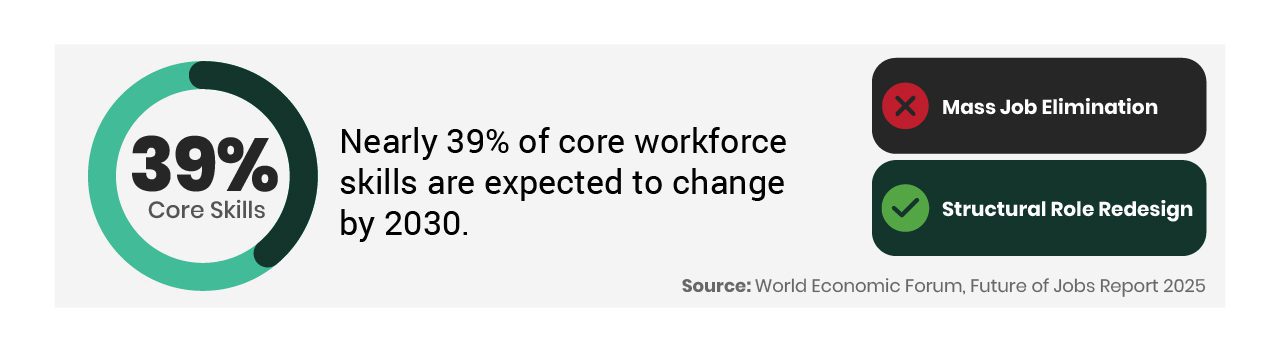
According to the World Economic Forum’s Future of Jobs Report 2025, nearly 39% of core workforce skills are expected to change by 2030. This does not signal mass job elimination. It signals structural role redesign. In practice, this is already visible: HR teams are expected to produce workforce analytics rather than reports, finance teams are expected to interpret dashboards rather than reconcile data, and managers are expected to lead change rather than supervise activity. The real constraint is therefore not whether organisations can fill vacancies, but whether they can continuously detect and respond to emerging capability gaps within existing roles fast enough to remain competitive.
This is where most organisations quietly begin to fail. The gap between evolving role demands and the internal systems designed to respond to those changes exposes a deeper structural issue. Workforce planning focuses on headcount stability, while capability requirements shift continuously beneath it.
Upskilling is often positioned as the solution to this gap, but in reality, it is frequently disconnected from it. While capability demands evolve, many organisations continue to operate with outdated job descriptions, generic training catalogues, and promotion systems that reward tenure and familiarity more than demonstrated skill development. As a result, learning activity increases without a corresponding increase in organisational capability.
Where Upskilling Quietly Fails
Many organisations assume that increased learning activity automatically produces workforce capability. This assumption is often incorrect. The core failure in many upskilling initiatives is not the absence of training, but the absence of a system that converts learning into operational performance. Upskilling efforts typically break down across four critical points:
First, learning is frequently disconnected from real operational capability gaps. Organisations launch broad training programmes, purchase learning platforms, and encourage course participation without first identifying the specific competencies constraining execution, productivity, or transformation objectives. As a result, employees may complete training that has little relationship to the actual demands of their roles or the organisation’s strategic priorities.
Second, even where learning content is relevant, employees are often given limited opportunity to apply new skills in practice. Capability develops through repeated use, problem-solving, feedback, and operational exposure, not solely through course completion. When workflows, job design, or managerial structures do not create room for application, learning retention declines rapidly, and behavioural change rarely becomes embedded.
Third, managerial reinforcement is frequently weak or inconsistent. Supervisors may approve training participation but fail to support post-training implementation through coaching, delegation, accountability, or performance expectations. In these environments, learning remains isolated from day-to-day operational culture, reducing the likelihood of sustained capability transfer.
Finally, organisations often measure learning activities rather than capability outcomes. HR functions may report participation rates, certification volumes, or training hours while business leaders continue to experience execution bottlenecks, recurring errors, low adaptability, and capability shortages. The organisation, therefore, mistakes educational activity for workforce transformation.
This pattern is well documented in workforce development research. Studies by the Association for Talent Development (ATD) and the landmark Broad and Newstrom training transfer research found that only a limited proportion of formal learning consistently translates into sustained workplace performance. Subsequent learning effectiveness research, including the widely referenced 70-20-10 Framework, reinforces the argument that capability development depends heavily on workplace experience, coaching, and applied learning rather than formal instruction alone.
Real capability is visible in operational outcomes. It appears in stronger analytical outputs, faster execution cycles, improved decision quality, reduced error rates, greater internal mobility, and stronger cross-functional performance. Where these outcomes do not improve, organisations may be increasing learning activity without meaningfully strengthening workforce capability.
Too often, upskilling is treated as a recurring programme rather than an operational discipline integrated into workforce strategy. This is where many organisations quietly lose momentum. They invest in training systems without building capability systems.
What Leading Organisations Are Doing Differently
The organisations making real progress on workforce capability are not necessarily those with the largest learning budgets or most courses available. They are the ones rethinking how capability is built, deployed, and measured across the business.
-
They Build Through Adjacency, Not Perfection
Leading organisations no longer define talent readiness by asking who is already perfectly qualified for the next role. Instead, they identify employees with adjacent capabilities and assess how quickly those individuals can be accelerated into higher-value functions. A payroll officer with strong data accuracy may transition effectively into HR analytics, while a project coordinator may already possess the stakeholder management and execution capabilities required for transformation roles.
This skills-based internal mobility approach expands the internal talent pool, reduces dependence on scarce external hires, and shortens time-to-productivity. Research from LinkedIn shows that employees who move internally remain with organisations significantly longer than external hires (64% retention compared to 45%), reinforcing the workforce value of building through adjacent capability rather than waiting for perfect-fit talent.
-
They Invest in Capabilities That Strategy Requires
High-performing organisations do not build learning agendas around popular courses or generic development programmes. They begin by identifying the capabilities their strategy will require within forward-looking workforce planning cycles, where current workforce weaknesses exist, and which gaps create the greatest operational or commercial risk.
This changes how capability investment is allocated. Rather than spreading learning resources broadly across the workforce, development efforts are concentrated on the skills most critical to execution, innovation, customer experience, efficiency, and competitiveness. Research from the Association for Talent Development and broader workforce development studies shows that organisations that align learning investment directly with business priorities are significantly more likely to report measurable improvements in workforce performance and organisational effectiveness.
-
They Use Skills Data to Drive Talent Decisions
Many organisations still make workforce decisions without clear visibility into the capabilities already present within their teams. Leading organisations are increasingly adopting skills-based workforce models that use capability data to guide promotions, succession planning, internal mobility, and workforce planning decisions.
This allows organisations to identify transferable skills more effectively, strengthen leadership pipelines, and redeploy talent in line with changing business priorities. It also improves decisions on whether capability gaps should be addressed through upskilling or external hiring. According to the World Economic Forum, 63% of employers identify skills gaps as a major barrier to business transformation. In comparison, approximately 39% of core workforce skills are expected to change by 2030, making workforce skills visibility increasingly critical to organisational adaptability.
-
They Measure Capability Through Business Outcomes
Leading organisations recognise that course completions and attendance figures are weak indicators of workforce capability if operational performance remains unchanged. Instead, they evaluate whether capability investment is improving execution through outcomes such as faster turnaround times, stronger reporting quality, reduced recurring errors, improved productivity, increased internal mobility, and stronger customer outcomes.
This reflects a shift from measuring learning activity to measuring performance impact. Research across workforce development studies shows that, while organisations continue to invest heavily in learning programmes, most still struggle to connect training activities directly to measurable business outcomes or performance improvements. In high-performing organisations, capability development is therefore assessed not by participation rates, but by observable improvements in operational execution and organisational performance.
Diagnostic Lens: A 30-Day Capability Reset
To assess whether an organisation is genuinely building capability or simply delivering training activity, a short-cycle diagnostic can be applied.
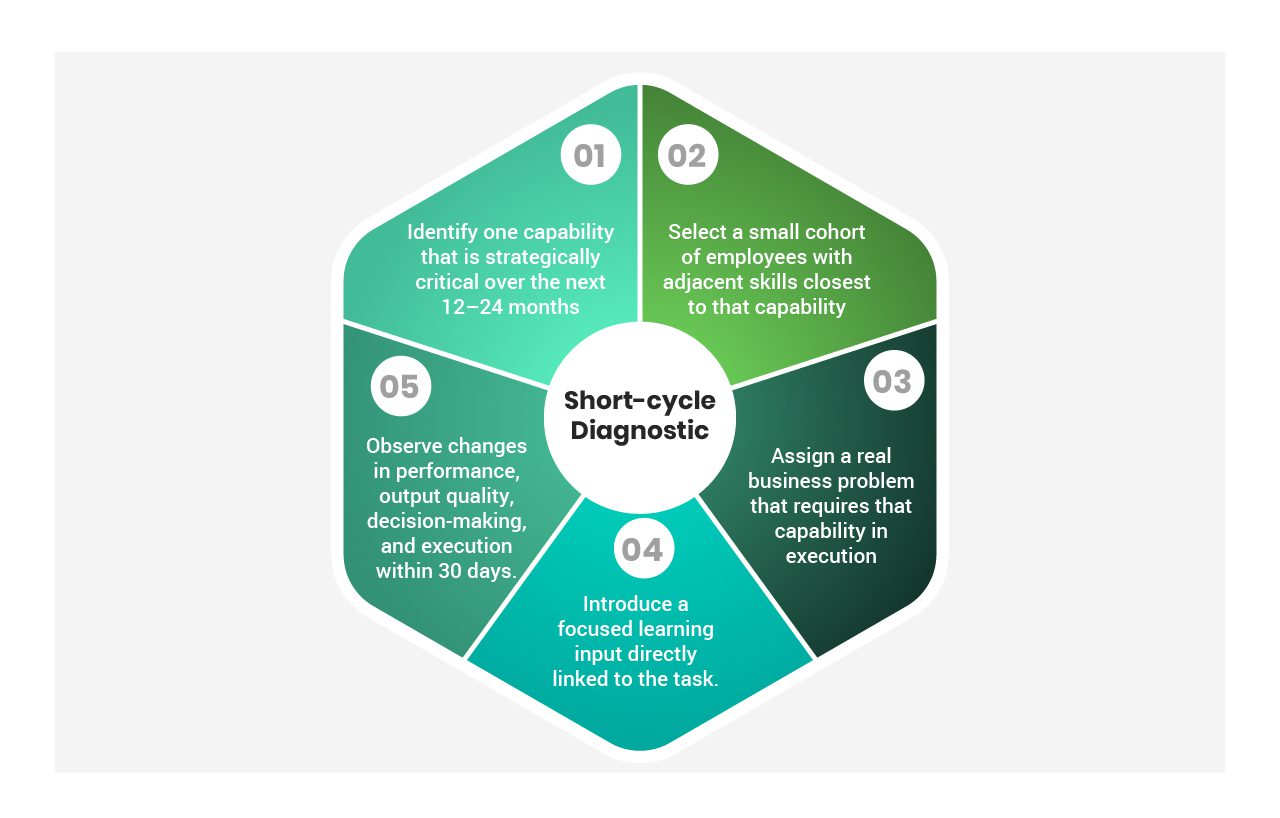
If no measurable shift occurs, the constraint is rarely individual willingness. It typically reflects a system failure in how learning connects to work, how managers reinforce behaviour, and how performance impact is defined and measured.
Conclusion
Most organisations are not short of training. They are short of translation. Knowledge is not consistently translated into behaviour, and behaviour is not consistently translated into performance. The gap shows up in execution through slow decision-making, recurring capability bottlenecks, and strategies that move faster than the workforce can keep pace.
The real question is not how much organisations invest in learning, but whether they have built a system that converts capability intent into operational reality. Without that system, talent remains constrained. With it, capability compounds into a sustained source of advantage rather than a recurring organisational gap.
This is the work of structured capability thinking. It requires moving beyond training activity toward intentional, measurable capability growth through systems that connect skills, work design, and performance outcomes in a continuous loop. This is the approach developed within pcl’s Skills Intelligence and Capability Systems practice.
For enquiries send an email to enquiry@phillipsconsulting.net
Author
Faith Agohukoh
Skills, Intelligence & Capability Systems