
Africa is entering a decisive leadership era. The continent possesses the world’s youngest population, expanding digital economies, abundant natural resources, and the largest free trade area by number of participating countries. Yet none of these advantages alone will determine Africa’s future. Leadership will.
Population pressure, rapid technological change, climate volatility, and a shifting global order are converging on the continent simultaneously. They are not distant trends arriving one at a time; they are present realities demanding a leadership response right now. The question has moved past whether Africa has the raw ingredients for transformation. The harder question, and the more urgent one, is whether it can produce the leaders capable of turning those ingredients into something lasting.
The future African leader will not emerge from a minor refinement of what came before. Incremental improvement on an outdated model produces a more polished version of inadequate. What is needed is a leader who is adaptive where predecessors were rigid, digitally fluent where they were dismissive, emotionally intelligent where they were transactional, and globally connected while remaining firmly African in orientation and instinct.
Nigeria sits at the centre of this conversation. As the continent’s most populous nation and largest economy, it is simultaneously the greatest proof of Africa’s potential and the most acute test of its leadership deficit. The challenges playing out in Lagos boardrooms, Abuja ministries, and Kano trading floors are not isolated problems in Nigeria; they are an early preview of what every major African economy will face within a generation.
Africa: A Continent in Motion
Recent African Development Bank updates point to a cautiously improving outlook: the Bank’s November 2025 macroeconomic update projected Africa’s real GDP growth at 4.2% in 2025 and 4.3% in 2026, an upgrade from the May 2025 African Economic Outlook projections of 3.9% and 4.0%, respectively. The World Bank estimates that full implementation of the AfCFTA could raise regional income by about $450 billion by 2035, while the United Nations Economic Commission for Africa projects that the agreement could increase intra-African trade by up to 45% by 2045.
At the same time, the continent is contending with underlying challenges that require leaders capable of navigating uncertainty without the comfort of precedent. Inflation, debt pressure, infrastructure gaps and youth unemployment remain serious constraints across several economies. Commonly cited labour-market estimates suggest that roughly 10 to 12 million young Africans enter the workforce each year, while only about 3 million formal jobs are created annually. Digital growth offers a meaningful but incomplete pathway, and only if leaders deliberately expand access rather than allowing opportunity to concentrate in already-connected markets.
These are not problems to be managed from a distance. They are leadership challenges that call for deep contextual intelligence, adaptive capacity, and a fundamental rethinking of what it means to lead in Africa. The policies and decisions made by today’s leaders will carry generational weight — for better or worse.
The New Leadership Approach
The dominant African leadership model has mirrored Western institutional frameworks, centred on hierarchy, technical expertise, and transactional authority. Those models served a particular era and context. They were not, however, designed for an operating environment as diverse, dynamic, and historically layered as Africa’s. The continent’s cultural plurality, its entrepreneurial informality, and the complex interplay between community obligation and individual aspiration all demand a different kind of leader.
The future African leader must first understand this context, not as a limitation to be apologised for, but as a source of competitive and moral advantage. That understanding is what separates leaders who import frameworks wholesale from those who can navigate complexity without being paralysed by it; hold firm convictions while remaining genuinely open to learning; see through the eyes of multiple stakeholders simultaneously; and draw on indigenous wisdom without dismissing global best practice. The mandate is not to choose between African and world-class. It is to insist that they are the same thing.
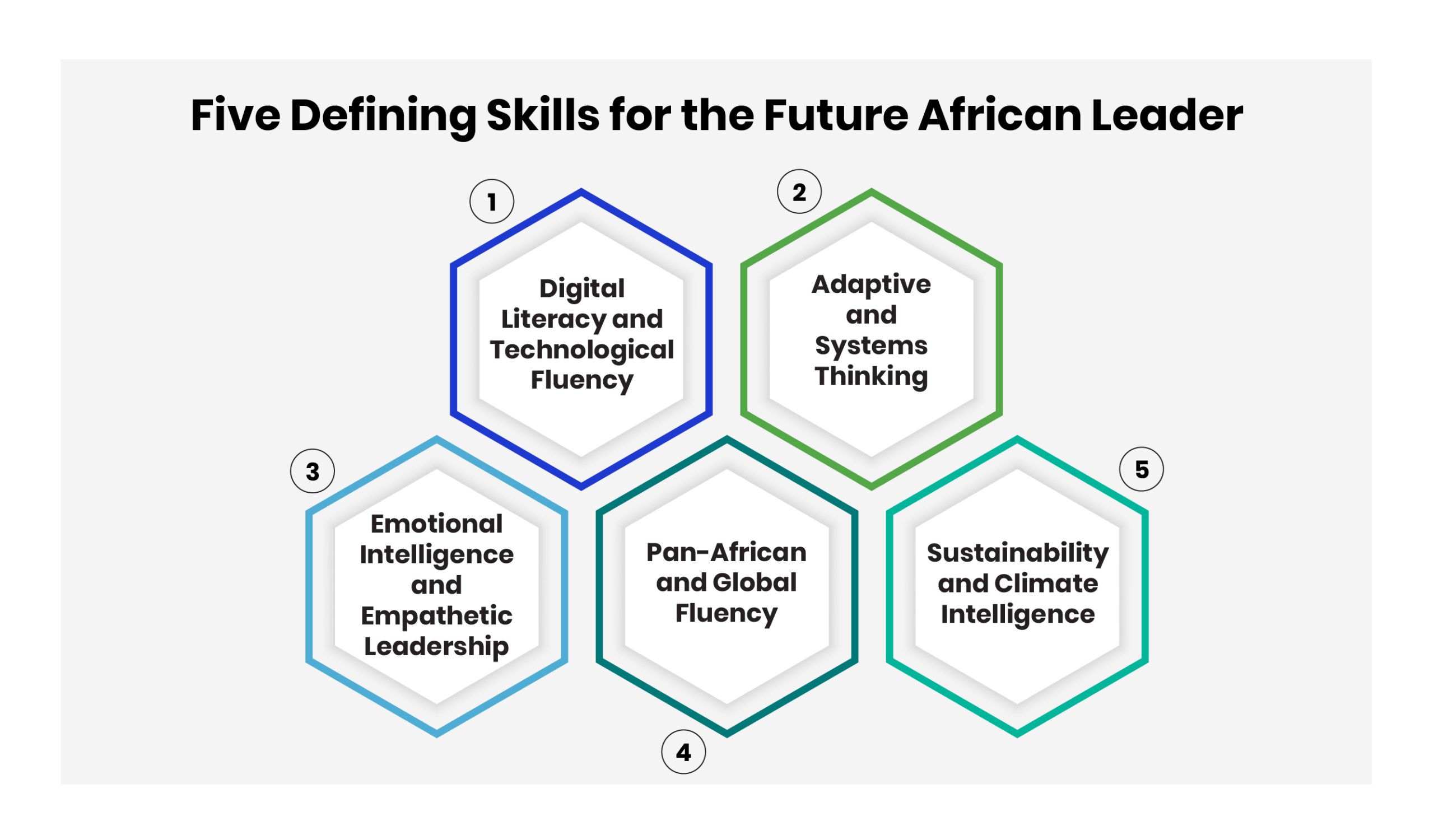
Five Defining Skills for the Future African Leader
For effective leadership in Africa in the decades ahead, five interconnected competencies stand out not as a checklist but as a constellation. They reinforce each other, and the absence of any one weakens the others.
Digital Literacy and Technological Fluency
The digital revolution is already underway in Africa, though unevenly distributed, and it is accelerating. GSMA’s Mobile Economy Africa 2025 report estimates that mobile technologies and services generated 7.7% of Africa’s GDP in 2024, equivalent to about $220 billion in economic value, with the contribution projected to reach about $270 billion by 2030. Yet the same report shows the scale of the access challenge: while 416 million people use mobile internet across Africa, almost three-quarters of the continent’s population remain unconnected.
That connectivity gap is not merely a development statistic. For leaders, it is a strategic frontier representing untapped markets, underutilised workforces and communities that digital disruption will reach, whether deliberately guided by visionary leadership or unevenly shaped by market forces. The future African leader must understand technology’s strategic implications, anticipate its disruptions ahead of the curve, and champion inclusive deployment rather than leaving access to chance.
Technological fluency is no longer optional. It is a core leadership capability spanning AI-informed decision-making, digital financial services, e-learning platforms and precision agriculture. The uneven distribution of advanced digital and AI capacity across the continent makes this even more urgent: leaders must broaden access to digital skills, research capacity and enabling infrastructure rather than allowing innovation to remain concentrated in a few markets.
Adaptive and Systems Thinking
Food insecurity, urban congestion, public health crises, and climate disruption do not respond to single-playbook solutions. These are systems problems, and leaders who treat them as linear challenges, identify the issue, apply the fix, and move on, will consistently fall short. Adaptive thinking means holding multiple hypotheses at once, iterating quickly when early evidence contradicts the plan, and recalibrating without losing direction.
Africa’s formal and informal economies are not parallel tracks; they are deeply intertwined, and policy environments can shift with little warning. In that reality, adaptive leadership is not a preference; it is a survival requirement. The leaders who will matter most are those who ask the right questions: not just what needs to change, but why it has not already, who it will affect, and at what pace change can realistically be absorbed.
Emotional Intelligence and Empathetic Leadership
The African workplace is multigenerational, multicultural, and in many organisations, undergoing rapid transformation. The psychological contract between employers and employees is being renegotiated in real time, shaped by post-pandemic expectations, the rise of remote and hybrid work, and an increasingly vocal demand for purposeful employment among younger workers. Leaders who rely on authority alone will find their influence diminishing faster than they expect.
Emotional intelligence, in this context, is not a soft skill sitting alongside strategy. It is what makes strategy executable. A leader who can recognise and manage their own emotional state, and read the emotional climate of those they lead, is a leader who can sustain performance through pressure, retain talent through uncertainty, and build cultures where people raise concerns before they become crises. Psychological safety is not an HR aspiration; it is a competitive infrastructure. Teams that can take productive risks, offer unconventional ideas, and flag early failures give their organisations an intelligence advantage that no individual leader, however brilliant, can replicate alone.
Pan-African and Global Fluency
Africa’s demographic momentum will reshape markets, workforces, partners and customers over the next generation. UN population projections show that Sub-Saharan Africa will account for a major share of global population growth through mid-century. At the same time, Nigeria is expected to remain one of the world’s most populous countries. These shifts are not abstractions; they are operating contexts that future African leaders must understand in depth.
The AfCFTA is the largest free trade area in the world by the number of countries. Pan-African leadership fluency, the ability to work effectively across national borders, language groups, regulatory environments, and cultural norms within Africa, is therefore a distinctly strategic competency, not a diplomatic nicety. The future African leader must know and respect the continent’s diversity, build coalitions across it, and credibly articulate Africa’s interests on the global stage. Leadership that is locally grounded but globally connected will define Africa’s most influential voices in the coming decade.
Sustainability and Climate Intelligence
Africa accounts for less than 4% of global greenhouse gas emissions, yet it experiences some of the worst effects of climate change, including droughts, flooding, food insecurity, and displacement. Despite these vulnerabilities, the continent also sits on a significant opportunity: it holds many of the critical minerals needed for the global transition to clean energy. This position could generate substantial economic value in the decades ahead.
This convergence of climate vulnerability and green economic opportunity places enormous demands on African leaders in both public and private sectors. It demands a generation that can integrate sustainability into everyday decision-making, champion climate resilience without waiting for global consensus, and position Africa not merely as a victim of climate change but as a principal actor in the world’s response.
The Mindset Shift – From Authority to Service
While skill acquisition matters, skills without the right mindset are incomplete. The deepest shift required of the future African leader is perhaps the most personal. It is the move from a passed-down leadership identity, one built around authority, status, and positional power, to one built around service, accountability, and shared purpose.
Leaders who understand their role as stewards rather than owners tend to inspire deeper loyalty, make more ethical decisions, and build organisations capable of outlasting any single individual. In an era when governance failures, institutional mistrust, and democratic backsliding present real risks across parts of the continent, leaders who model integrity and accountability at the organisational level make a contribution that extends far beyond the balance sheet.
This shift is not idealism. It is a practical response to the conditions in which African leaders now operate. In an environment where talent has options, including, increasingly, the option to leave the continent entirely, the leader who retains the best people is rarely the one with the most impressive title. It is the one whose teams feel their work has meaning, that their growth is invested in, and that failure will be treated as a learning opportunity rather than as evidence of inadequacy. The authority-based leader loses people to Japa. The service-oriented leader builds something that makes Japa less necessary.
Building the Pipeline: The Role of Organisations
Individual leaders do not emerge in isolation. They emerge from systems, from the organisations, institutions, and governments that either create conditions for leadership to develop or quietly starve it of oxygen. The pipeline question is therefore not simply about identifying talented individuals; it is about asking whether the environment in which those individuals work accelerates their growth or bureaucratises it.
Organisations that are serious about the next generation of African leaders will treat continuous professional development not as an annual event but as an embedded expectation woven into how work gets done. Mentorship should flow in multiple directions, senior to junior, yes, but also across functions, geographies, and experience levels. Talent management systems must be redesigned to identify high-potential individuals early and invest in them deliberately, rather than waiting for brilliance to announce itself through conventional routes. The leadership pipeline must actively reflect Africa’s full range of voices. Women remain significantly underrepresented at senior levels across most sectors on the continent, a gap that represents not only an equity failure but a strategic one, given the leadership capacity being left on the table.
Conclusion
Africa enters the next quarter-century with extraordinary endowments: a youthful population, expanding digital markets, continental trade ambitions, and demographic momentum few regions can match. None of it is self-executing. These are inputs, not outcomes, and Africa’s future will be shaped above all by the quality of its leadership.
Just as raw materials require processing, the future African leader requires formation, deliberate investment in vision, technical fluency, emotional depth, cross-cultural competence, and an unwavering orientation toward service. This leader is not a replica of models designed elsewhere and awkwardly imported. They are adaptive, analytically rigorous, empathetic, and strategically bold, and they carry both digital fluency and cultural groundedness, understanding that sustainability is not a theme but a condition of long-term relevance, and that inclusion is not a concession but the only honest measure of whether leadership is working.
Africa is not waiting for leadership; it is demanding it. The institutions, organisations, and individuals that answer that demand with seriousness and intentionality will help write the most consequential chapters in the continent’s story.
As an indigenous African consulting firm, Phillips Consulting strives to build the competencies of individuals and organisations through a range of leadership learning initiatives, including instructor-led and digital training. Please contact us today at enquiry@phillipsconsulting.net so we can work with you on the journey to build Africa’s future leaders.
Author
Christian Edohor