
A Deep Dive into Transforming Customer Engagement Through Emerging Technologies and Customer-Centric Models
Customer experience has become one of the strongest drivers of business success in the digital economy. While organisations once competed primarily on price, product quality, or market reach, today’s customers increasingly differentiate brands based on the quality of the experiences they deliver. Every interaction, from discovering a product to receiving post-purchase support, shapes customer perceptions, trust, and loyalty.
Digital technologies have fundamentally changed customer expectations. Customers now expect seamless, personalised, and convenient experiences across every touchpoint. According to Salesforce’s State of the AI Connected Customer, based on responses from more than 14,000 consumers and business buyers worldwide, 73% of customers say companies treat them more like individuals than numbers, while 71% are more protective of their personal data. These findings highlight a growing expectation for organisations to balance personalisation with transparency and trust.
Meeting these expectations requires more than adopting new technologies. Organisations must rethink how they design customer journeys, remove unnecessary friction, and use digital innovation to create experiences that are simple, responsive, and customer-centric. Those that succeed will be better positioned to strengthen customer loyalty, improve satisfaction, and build sustainable competitive advantage in an increasingly digital marketplace.
Understanding the New Digital Customer
Digital transformation has fundamentally reshaped customer expectations. Customers no longer compare organisations solely with direct competitors. Instead, they benchmark every interaction against the best digital experiences they encounter, whether ordering from an online retailer, streaming entertainment, booking travel, or managing their finances through a mobile application.
This shift has elevated customer experience from an operational function to a strategic imperative. Customers expect organisations to provide intuitive digital interfaces, transparent information, rapid responses, and seamless interactions across multiple channels. Delays, fragmented processes, or inconsistent communication are no longer viewed as minor inconveniences but as indicators of poor service quality.
As a result, organisations are increasingly competing on the quality of the experience they deliver. Businesses that minimise customer effort and enable seamless interactions are more likely to build trust, strengthen loyalty, and encourage long-term engagement.
The Rise of Self-Service
One of the defining characteristics of modern customer experience is the growing preference for self-service. Digital customers increasingly want the flexibility to access information, complete transactions, and resolve routine issues independently, without waiting for assistance.
This preference is not a rejection of human interaction. Rather, it reflects a desire for greater convenience and control. Customers expect organisations to automate straightforward tasks while ensuring knowledgeable employees remain available for more complex or sensitive issues.
The preference for self-service is also reflected in industry data. ServiceNow reports that 28% of customers will stop trying to solve a problem if they cannot find an answer online, highlighting the importance of clear, searchable, and reliable digital support channels.
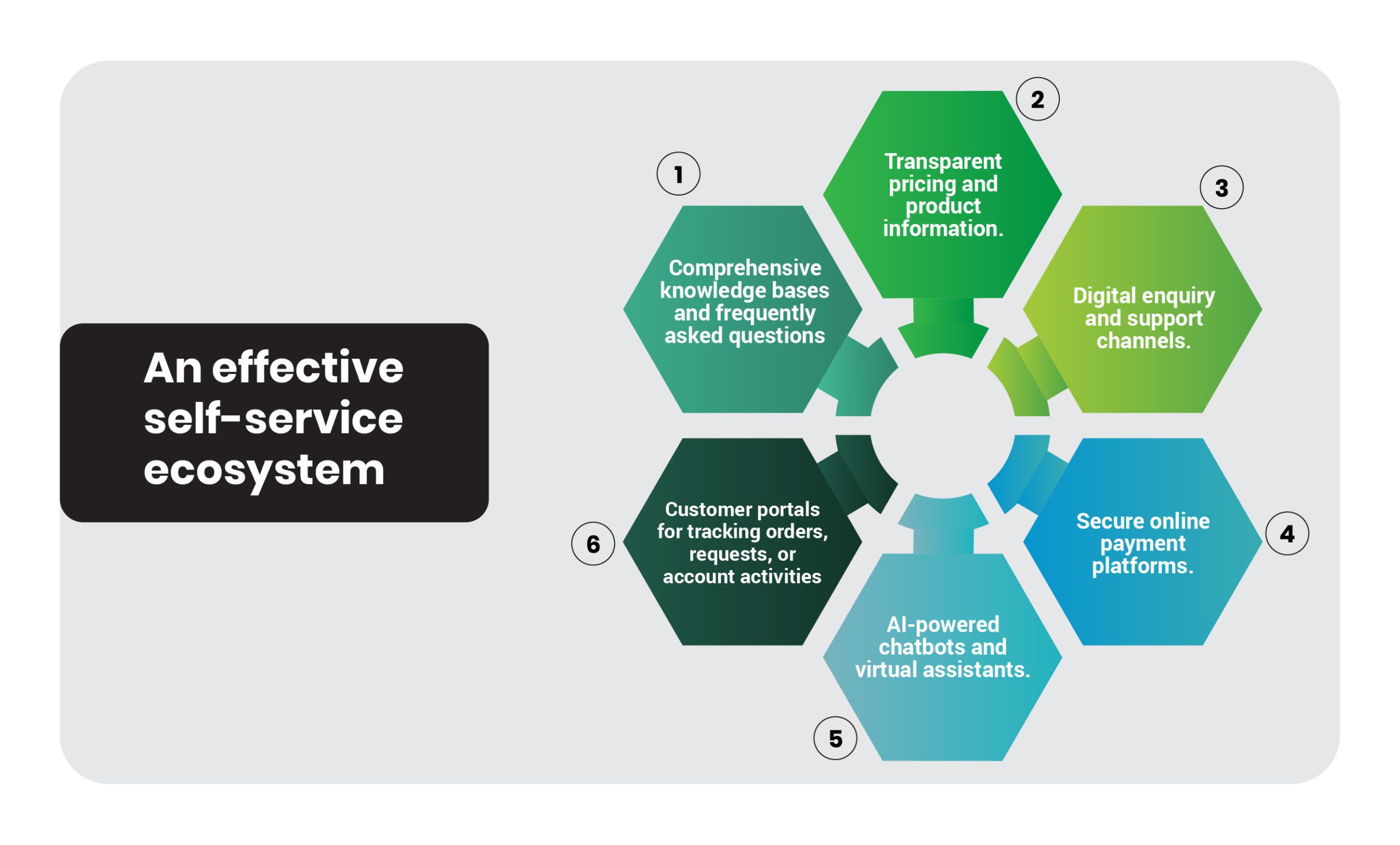
When these capabilities are well designed, organisations reduce customer effort while simultaneously improving operational efficiency. Employees spend less time handling repetitive enquiries and can focus on higher-value interactions that require expertise and empathy.
Leveraging Emerging Technologies to Transform Customer Experience
Emerging technologies are enabling organisations to deliver experiences that are faster, more personalised, and increasingly proactive.
Artificial intelligence is helping businesses analyse customer behaviour, predict future needs, and provide personalised recommendations at scale. Machine learning algorithms continuously improve these recommendations by learning from customer interactions, while conversational AI allows organisations to provide immediate assistance around the clock.
Customer attitudes toward AI also show why governance and transparency matter. Salesforce research indicates that 61% of customers believe advances in AI make it even more important for companies to be trustworthy, while 72% say it is important to know when they are communicating with an AI agent.
Automation eliminates repetitive manual processes, reducing delays in service delivery and enabling faster responses to customer requests. Cloud technologies support consistent experiences across multiple channels by ensuring customers can move seamlessly between websites, mobile applications, contact centres, and physical locations without losing continuity.
Data analytics also plays a crucial role by converting customer interactions into actionable insights. Organisations can identify pain points, monitor satisfaction trends, anticipate emerging needs, and continuously refine customer journeys based on evidence rather than assumptions.
Together, these technologies enable organisations to shift from reactive customer service towards proactive customer engagement.
Evidence from customer experience technology providers also indicates that businesses are moving quickly in this direction. Zendesk’s 2024 CX Trends Report found that 70% of customer experience leaders are reimagining customer journeys using tools such as generative AI, and 83% of those already using generative AI in customer experience reported positive return on investment.
Case Study
Amazon’s Customer-Centric Ecosystem
Amazon is widely recognised as one of the world’s leading examples of customer-centric innovation. While its extensive product catalogue contributes to its success, the company’s competitive advantage lies in the simplicity and consistency of the customer journey.
From intelligent product recommendations and one-click purchasing to real-time delivery tracking and streamlined returns, every stage of the purchasing process has been designed to minimise customer effort. These capabilities reduce uncertainty, simplify decision-making, and provide customers with greater confidence throughout their interaction with the platform.
The scale of Amazon’s customer model illustrates why frictionless digital journeys matter. In its 2023 annual report, Amazon stated that net sales increased by 12% to $574.8 billion in 2023, reflecting the commercial strength of a model built around broad selection, convenience, speed, and customer trust.
Amazon demonstrates an important principle of customer experience design: convenience is not an additional feature; it is a strategic capability that influences customer satisfaction, retention, and long-term loyalty.
Digital Transformation in Banking
The banking industry provides another compelling example of customer experience transformation. Historically, many banking services required customers to visit physical branches for routine transactions such as transfers, account enquiries, bill payments, or card management.
Today, digital banking platforms allow customers to perform these activities securely via mobile applications and online portals at any time, from virtually any location.
The scale of this shift is visible in global financial inclusion data. The World Bank’s Global Findex 2021 reported that the share of adults in developing economies making or receiving digital payments rose from 35% in 2014 to 57% in 2021, showing how digital channels have become central to everyday financial activity.
Beyond convenience, digital banking has fundamentally changed customer expectations. Customers now expect immediate access to services, real-time transaction notifications, digital onboarding, personalised financial insights, and responsive virtual support.
For financial institutions, this transformation has reduced operational costs, improved service availability, and strengthened customer satisfaction while allowing branch staff to focus on more complex advisory services.
Designing Experiences That Build Loyalty
The experiences delivered by organisations such as Amazon and leading digital banks highlight a common principle: exceptional customer experience is intentionally designed rather than achieved by chance.
Successful organisations invest in understanding customer behaviour, identifying friction points, simplifying interactions, and continuously improving service delivery through technology and customer feedback.
They recognise that every unnecessary form, repeated request, delayed response, or unclear process increases customer effort and creates opportunities for competitors to deliver a better experience.
Ultimately, customer loyalty is earned by consistently making interactions simple, efficient, and trustworthy.
Measuring Customer Experience
Delivering exceptional customer experience requires more than intuition. Organisations must continuously measure performance to understand how customers perceive their interactions and where improvements are needed.
Common customer experience metrics include:
- Customer Satisfaction Score (CSAT): Measures customer satisfaction following a specific interaction or transaction.
- Net Promoter Score (NPS): Assesses customers’ willingness to recommend the organisation to others.
- Customer Effort Score (CES): Evaluates how easy it was for customers to complete a task or resolve an issue.
- First Response Time (FRT): Measures the speed at which customer enquiries receive an initial response.
- Average Resolution Time (ART): Tracks the time required to resolve customer issues completely.
- Self-Service Success Rate: Measures the percentage of customer requests resolved through digital self-service channels without requiring human intervention.
Monitoring these indicators enables organisations to identify service gaps, evaluate improvement initiatives, and make evidence-based decisions that enhance customer satisfaction.
Why Customer Experience Is a Strategic Investment
Many organisations focus significant resources on product development, marketing, and sales while underestimating the influence of customer experience on long-term business performance.
Customers rarely evaluate a product in isolation. They assess the entire journey, from discovering information and comparing options to making purchases, receiving support, and resolving issues. A positive experience strengthens trust and encourages repeat business, while a frustrating experience can discourage future engagement regardless of product quality.
Organisations that invest strategically in customer experience often realise benefits beyond improved satisfaction. They experience stronger customer retention, increased lifetime value, higher referral rates, greater operational efficiency, and enhanced brand reputation. In increasingly competitive markets, these outcomes represent sustainable sources of competitive advantage.
Conclusion
Reimagining customer experience in the digital age requires organisations to move beyond viewing customer service as a standalone function. Instead, customer experience should be embedded within organisational strategy, operational processes, technology investments, and organisational culture.
Emerging technologies, including artificial intelligence, automation, cloud computing, and advanced analytics, provide unprecedented opportunities to create personalised, efficient, and seamless customer journeys. However, technology delivers value only when it is guided by a deep understanding of customer needs and a commitment to reducing unnecessary complexity.
The experiences of organisations such as Amazon and digitally transformed financial institutions demonstrate that successful customer experience strategies are built on simplicity, accessibility, transparency, and continuous improvement. Businesses that consistently reduce customer effort and empower customers through intuitive digital experiences are better positioned to earn trust, strengthen loyalty, and achieve sustainable growth.
In an increasingly digital marketplace, competitive advantage will belong not only to organisations with the best products or services but also to those that deliver the most effortless, consistent, and meaningful customer experiences.
Author
Miracle Akingbelure