
Building a market where producing in Nigeria is more competitive than importing into it
Nigeria has long been recognised as a country of extraordinary economic potential. It possesses one of Africa’s largest consumer markets, significant crude oil and natural gas reserves, and a broad base of solid mineral and agricultural resources. With a population exceeding 237 million, the country offers manufacturers access to a large and growing base of demand that many developing economies can only aspire to (World Bank, 2026). Yet this abundance has not translated into a resilient production economy. Nigeria continues to rely heavily on imported manufactured goods, industrial inputs and consumer products. This dependence leaves households and businesses exposed to exchange rate shocks, global supply chain disruptions and rising production costs.
Successive economic reforms have sought to address this challenge through import restrictions, border controls, tariff adjustments and foreign exchange policies. While these interventions have produced varying degrees of short-term relief, they have not fundamentally altered the structure of Nigeria’s domestic market. Manufacturing continues to account for less than one-tenth of the country’s gross domestic product (World Bank, 2026). At the same time, businesses continue to face high energy costs, inefficient transport networks, limited access to affordable financing and fragmented supply chains, all of which reduce the competitiveness of locally produced goods before they even reach the marketplace.
Perhaps the more important question, therefore, is not whether Nigeria should produce more locally, but whether the domestic market itself is structured to reward production, innovation and fair competition. A competitive domestic market does more than connect producers with consumers. It provides transparent price signals, discourages exploitative market practices, attracts investment and enables businesses to scale with confidence. Until Nigeria reforms the market in which its producers compete, local production will continue to struggle against structural inefficiencies rather than market competition. If industrialisation is to become more than a national aspiration, then the country’s next major economic reform must begin not at its borders, but within its domestic market.
The Reform Gap We Have Overlooked
For decades, Nigeria’s industrialisation agenda has largely been framed around increasing local production. Governments have introduced import substitution policies, adjusted tariffs, restricted access to foreign exchange for selected imports and, at various points, implemented border closures to encourage domestic manufacturing. These interventions were designed to protect local industries from external competition and stimulate investment in productive sectors. While they addressed important policy concerns, they often treated the symptoms of Nigeria’s industrial challenges rather than the domestic market conditions that determine whether local businesses can compete sustainably.
The success of local production depends not only on what happens inside a factory, but also on what happens after products enter the market. Manufacturers that overcome unreliable electricity, high borrowing costs and expensive logistics still face a domestic marketplace characterised by significant price disparities, fragmented distribution networks and information asymmetry. Similar products are often sold at markedly different prices across markets, with limited publicly available information to explain all variations.
This is where Nigeria’s next economic reform should begin. A strong domestic market is not one where government determines prices, but one where markets operate transparently, competition is protected, and consumers have access to reliable pricing information. Businesses should compete by improving productivity, innovation and efficiency rather than exploiting information gaps or market distortions. The role of government is therefore not to replace market forces, but to strengthen the institutions that allow markets to function fairly. Reforming the domestic market is not an alternative to industrial policy; it is the foundation upon which successful industrial policy is built.
Why the Domestic Market Is Not Working
Nigeria’s domestic market has the potential to be one of the country’s greatest economic assets. With a large consumer base and growing entrepreneurial activity, it should naturally stimulate production, encourage innovation and strengthen industrial competitiveness. Instead, structural inefficiencies continue to increase the cost of doing business, weaken market confidence and limit the ability of local producers to compete effectively. Four interrelated challenges illustrate why the domestic market has become a critical area for reform.
1. The Cost of Production Remains Too High: Local manufacturers continue to operate in a high-cost business environment. An unreliable electricity supply, reliance on alternative energy sources, poor transport infrastructure, multiple taxes, and high lending rates significantly increase production costs. According to the Manufacturers Association of Nigeria (2024), energy costs, logistics expenses, foreign exchange volatility and high interest rates remain among the most significant constraints to manufacturing performance. When production becomes expensive, locally manufactured goods lose their competitive advantage even before reaching the market.
2. Price Discovery Is Inefficient: Competitive markets depend on transparent and reliable pricing information. In Nigeria, however, consumers often encounter substantial price differences for similar products across markets, with limited information to explain these variations. While some differences are driven by transport, supply and seasonal factors, limited market transparency can also create opportunities for information asymmetry and inefficient pricing.
3. Market Oversight Must Be Strengthened: A competitive market requires more than willing buyers and sellers; it requires institutions that discourage anti-competitive behaviour and protect consumers. The Federal Competition and Consumer Protection Commission (2024) has acknowledged that although exchange rate depreciation and inflation contribute to rising prices, prices charged in some cases remain disproportionate or excessive. The Commission has therefore intensified its focus on exploitative pricing, consumer protection and fair competition, recognising that market confidence depends on effective regulatory oversight.
4. Market Inefficiencies Weaken Industrial Growth: Industrialisation extends beyond increasing factory output. It also requires a domestic market that rewards productivity, encourages investment and provides businesses with predictable market conditions. Where production costs remain high, pricing lacks transparency, and competition is weakened, businesses become less willing to expand, investors become more cautious, and consumers experience declining purchasing power. Under such conditions, export competitiveness becomes increasingly difficult to achieve because strong export economies are built upon strong domestic markets.
These structural constraints are not unique to Nigeria, nor are they beyond reform. Around the world, countries that have successfully strengthened local industries have done so by improving the institutions that govern their domestic markets. For Nigeria, the next step is therefore not simply to produce more, but to create a market environment in which local production can compete, grow, and ultimately succeed both at home and abroad. That raises the next question “What reforms are required to transform Nigeria’s domestic market from a constraint on industrial growth to a catalyst for it?”
The Reform Nigeria Needs
Nigeria does not need a return to pervasive price controls. It needs institutions that make markets more transparent, competitive and efficient. A practical reform agenda should therefore focus on four priorities.
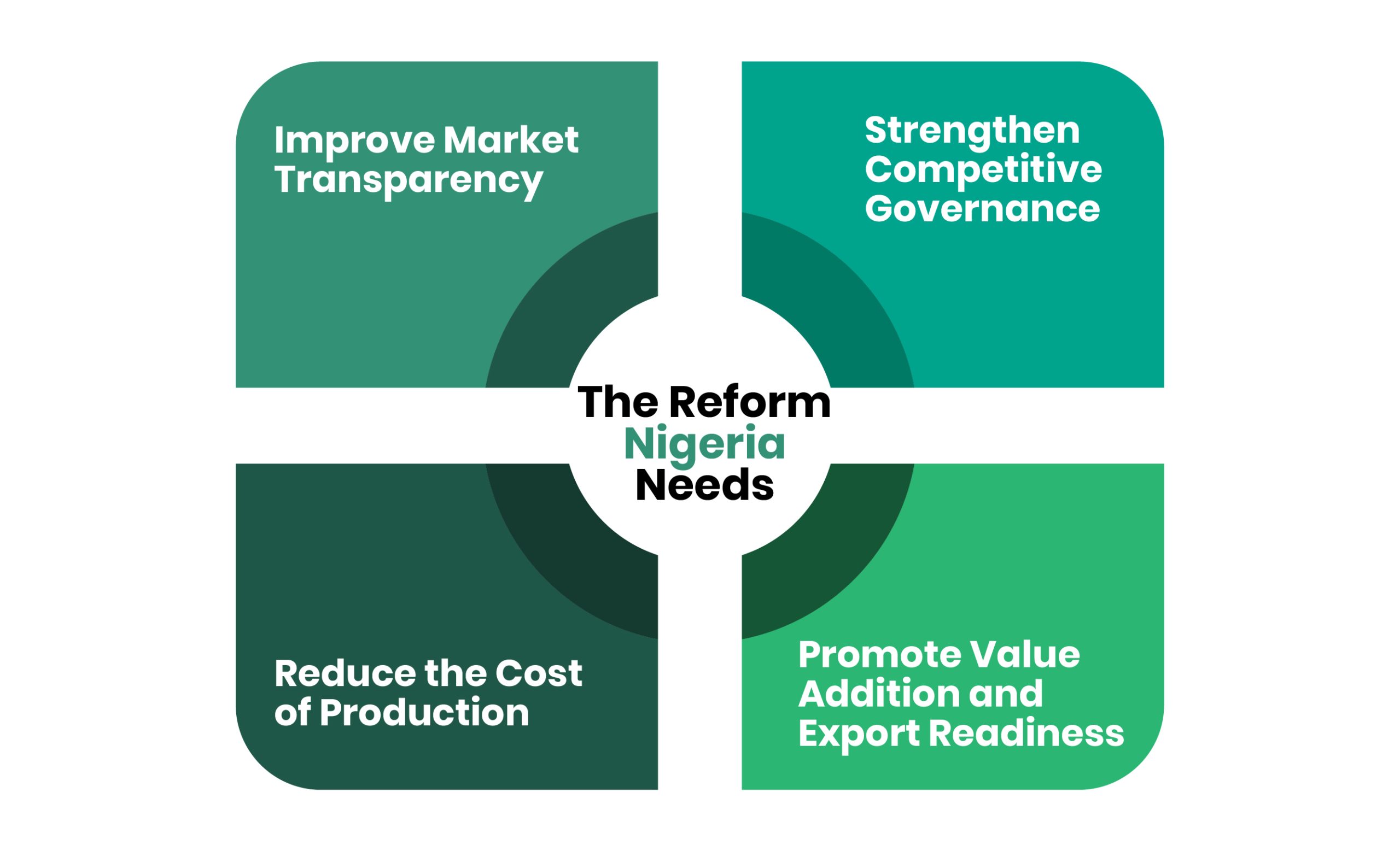
- Improve Market Transparency: Building on the data already collected by the government, Nigeria should establish a digital market intelligence system that publishes timely wholesale and retail prices across major markets. Better information would enable consumers to make informed choices, help producers identify opportunities and allow policymakers to detect emerging shortages and unusual price movements before they become systemic.
- Strengthen Competitive Governance: Competition policy must be enforced consistently to deter collusion, price fixing and other anti-competitive practices. At the same time, clear pricing standards and consumer education can reinforce trust in the marketplace without distorting legitimate market signals.
- Reduce the Cost of Production: Investments in reliable power, efficient transport networks, storage infrastructure and affordable industrial finance are essential. The most effective way to lower prices sustainably is not to cap them, but to reduce the underlying costs borne by producers.
- Promote Value Addition and Export Readiness: Nigeria should increasingly reward the processing of raw materials into higher-value products for both domestic consumption and export. A strong home market gives firms the scale, confidence and operational discipline required to compete internationally.
Reforming the domestic market is therefore not a substitute for industrial policy; it is the means by which industrial policy delivers lasting results. The final question is whether Nigeria is prepared to treat its domestic market not merely as a venue for trade, but as a strategic asset for national development.
Conclusion
Nigeria’s long-term prosperity will not be secured by import restrictions alone, nor by the abundance of its natural resources. It will depend on the country’s ability to build a domestic market that rewards productivity, protects competition and provides clear signals for investment and innovation. When producers can compete fairly, consumers can purchase with confidence, and institutions can respond swiftly to market distortions; local production becomes not merely viable but globally competitive.
The path from import dependence to export strength, therefore, begins at home. By treating the domestic market as a strategic reform priority, Nigeria can lay the foundation for a more resilient, inclusive and industrialised economy. The factories, farms and entrepreneurs capable of driving this transformation already exist. The task ahead is to create a market environment in which they can thrive.
How pcl. Can Support
pcl. can support public and private sector stakeholders by providing market diagnostics, competitiveness assessments, policy and regulatory advisory services, value chain analysis, price and market intelligence frameworks, and implementation support for reforms that strengthen domestic production and improve market efficiency. By translating data into actionable strategies, pcl. can help build the transparent and competitive domestic market that Nigeria needs to unlock sustainable industrial growth.
Author
Kolawole Sunday