

Stories Rooted in Ibadan, Lagos, and Beyond
Picture Tunde Ogboyari, a young graduate from the University of Ibadan, stepping into the fast-paced environment of a mid-sized consulting firm in Lagos. Armed with digital skills gained through Nigeria’s 3 Million Technical Talent Programme, he hoped to build a meaningful career in a sector that demanded more than academic knowledge alone.
Across the city, Adewale Olaijobe, an experienced e-learning developer, made a different transition. He moved from the flexible world of agency work into the structured, high-performance consulting environment at Phillips Consulting. For him, success was no longer only about creative execution; it was about solving client problems with strategy, structure, measurable outcomes, and business discipline.
Their stories reflect a larger shift. Nigeria’s consulting sector is no longer just a support service for large corporations. It is becoming part of the country’s knowledge economy: a platform for productivity improvement, digital adoption, talent development, SME transformation, and export of professional services.
Public market estimates for the consulting industry vary depending on how the sector is defined and on the scale used for measurement. Deep Market Insights places the global business management consulting services market at US$320 billion in 2025, with growth anticipated to US$561.09 billion by 2034. Mordor Intelligence, applying a narrower, Nigeria-specific definition of management consulting services, estimates the local market at US$1.58 billion in 2025, growing at a compound annual growth rate (CAGR) of 4.5% to reach US$1.97 billion by 2030.
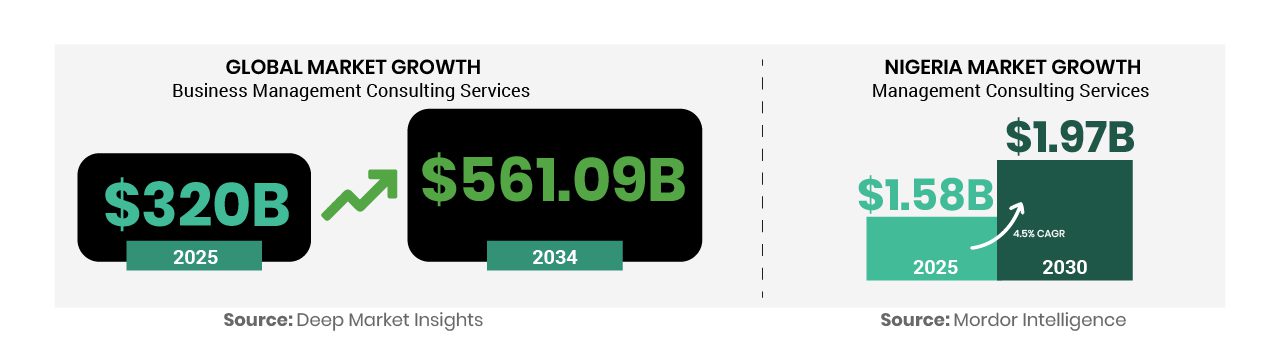
While the variation in scope and methodology across these estimates is notable, the underlying trend is unambiguous: advisory capability is becoming increasingly central to how Nigerian organisations compete, adapt, and grow.
The Rise of the Knowledge Economy
Services, digital capability, data, professional expertise, and institutional problem-solving are gradually shaping Nigeria’s economy. In this environment, value is no longer created only by factories, oil wells, trading networks, or physical assets. Increasingly, it is created by the ability to diagnose problems, design systems, interpret data, improve operations, build talent, and execute change.
This is where consulting becomes economically important. Consulting sits at the intersection of knowledge and implementation. It helps organisations convert uncertainty into decisions, strategy into execution, and fragmented effort into measurable performance.
For young professionals like Tunde, the knowledge economy is not an abstract idea. It is the difference between having a degree and being able to solve a real client problem. When he was assigned to support a cassava-processing SME in rural Oyo State, his academic knowledge was quickly tested by unreliable internet, rising input costs, weak supply chain reliability, and sceptical stakeholders.
The lesson was immediate: in Nigeria, consulting is not delivered in perfect conditions. It is delivered in markets where infrastructure is uneven, client resources are constrained, and solutions must be practical enough to survive local realities.
Consulting as a Productivity Multiplier
The strongest case for consulting is not that it produces reports. It improves the productivity of other sectors.
A manufacturing company that reduces waste, a bank that improves customer onboarding, a public-sector agency that redesigns service delivery, a school that strengthens digital learning, or an SME that uses data to manage inventory more effectively may all generate performance gains through consulting support.
Tunde’s cassava-processing assignment demonstrates this clearly. The project began with familiar challenges: poor connectivity, vendor disruption, rising costs, and low trust among rural stakeholders. Rather than rely only on presentations, he spent time with farmers, mapped the supply chain, and used Power BI to build simple dashboards that exposed waste points and operational delays. When a vendor withdrew, he used local networks to identify alternatives and rebuilt the client’s confidence with practical, data-backed projections. The result was not just a better presentation. It was a stronger operating model for an SME working in a difficult environment.
This is the productivity multiplier role of consulting. It helps organisations see where value is leaking, where processes are failing, where technology can improve decision-making, and where people need clearer systems to perform. For Nigeria, this matters because productivity growth is not only a corporate issue but also a national competitiveness issue.
Consulting as a Talent Development Engine
Consulting also plays another critical role: it develops talent quickly. The sector forces young professionals to think across industries, solve unfamiliar problems, manage deadlines, work with data, communicate with clients, and translate ideas into action. A graduate who spends two years in a strong consulting environment can gain exposure that might take much longer in a narrowly defined corporate role.
This is where government talent pipelines, such as the 3 Million Technical Talent Programme, become important. By 2026, 3MTT had trained over 160,000 fellows across three cohorts, with 1.87 million Nigerians registered and in the pipeline. For consulting firms, this creates a growing pool of digital talent that can support research, data analysis, automation, product design, digital transformation, learning technology, and implementation.
Adewale’s transition at Phillips Consulting shows how this talent model works in practice. Coming from an e-learning and creative technology background, he initially struggled with the consulting demand for deeper structure and business logic. His first major presentation received difficult feedback: the visuals were strong, but the business framework lacked depth.
Instead of resisting the shift, he adapted. He combined his knowledge of React, Node.js, learning design, and digital platforms with a consulting discipline. He built dashboards that helped clients visualise implementation timelines, learner engagement, and projected return on investment. He also used storyboard-driven learner journeys to translate technical ideas into business outcomes that clients could understand.
This blend of creativity, technology, and business thinking is becoming increasingly valuable. The World Economic Forum’s Future of Jobs Report 2025 identifies technology-related roles such as Big Data Specialists, FinTech Engineers, AI and Machine Learning Specialists, and Software and Applications Developers among the fastest-growing roles globally. For Nigeria’s consulting sector, this means the future consultant will not only be a strategy generalist. The future consultant will need to be data-literate, digitally fluent, commercially aware, and able to manage change in complex environments.
There is also an opportunity to connect consulting firms more deliberately with universities and NYSC. Some advisory and research firms are already absorbing corps members into support roles such as survey data analysis, research assistance, project coordination, data cleaning, reporting, and documentation. With better structure, consulting firms could convert NYSC and graduate programmes into a stronger entry-level analyst pipeline for the sector.
Consulting as an Export Industry
Nigeria’s consulting opportunity is not only domestic. As African businesses, governments, development institutions, and investors seek context-aware advisory support, Nigerian consulting firms are increasingly well-positioned to export expertise.
This is already happening in different forms. Phillips Consulting serves clients across West Africa through business advisory, people transformation, technology, international development, and learning programme management.
The export opportunity is important because consulting is a knowledge service. It does not require Nigeria to ship physical goods before it earns value outside its borders. It requires credibility, specialist capability, trusted methodologies, sector expertise, and the ability to solve African problems from an African context.
This is where Phillips Consulting has an advantage. They understand fragile infrastructure, complex regulation, informal-market dynamics, talent gaps, public-sector constraints, SME realities, and the pressure to deliver results despite uncertainty. These are not weaknesses alone; they are sources of practical expertise that can be valuable in other emerging markets.
If properly developed, consulting can become part of Nigeria’s non-oil export story.
What Must Happen Next
For consulting to become a stronger economic engine, the ecosystem must become more intentional.
Universities need to move beyond theory-heavy instruction and expose students to real business cases, data analysis, research methods, project management, problem-solving, and client communication. Consulting clubs, case competitions, industry-led capstone projects, and structured internships can help students understand how knowledge is applied in real organisations.
The government also has a role to play. Programmes like 3MTT are important, but digital training must be connected to placement pathways, SME transformation projects, public-sector innovation, and the promotion of professional services exports. Government procurement can also create room for capable local consulting firms to participate in national transformation projects, especially where the local context is critical to execution.
Professional bodies must strengthen standards, ethics, certification, and continuing professional development. As the sector grows, credibility will matter. Stronger professional standards will help clients distinguish between real advisory capability and generic consulting labels.
Consulting firms must also act as ecosystem builders. This means investing in graduate analyst programmes, NYSC pipelines, university partnerships, mentorship systems, knowledge management, research publications, and sector-specific capability development. Firms that consistently build people will not only grow their own talent base; they will also strengthen the market.
Private-sector organisations must also change how they view consulting. Consulting should not be treated merely as a cost or a last-minute intervention when problems become urgent. Used properly, it is an investment in productivity, execution, capability building, and long-term competitiveness.
Conclusion: Consulting as National Infrastructure for Competitiveness
Tunde’s lessons on a cassava farm in Oyo State and Adewale’s lessons in a Lagos boardroom point to the same truth: consulting in Nigeria is earned in the gap between theory and reality.
It is the work of translating strategy into action, data into decisions, technology into adoption, and talent into performance. It is helping SMEs become more resilient, helping large organisations transform, helping young professionals build high-value skills, and helping Nigerian expertise travel beyond national borders.
Nigeria’s consulting sector is not waiting for perfect conditions. It is being built by professionals who are learning, adapting, solving, and delivering despite difficult conditions.
The question for CEOs, HR leaders, policymakers, universities, and young professionals is no longer whether consulting has a future in Nigeria. The question is whether we will build the systems, standards, partnerships, and talent pipelines needed to make it one of the country’s strongest engines of the knowledge economy.
Phillips Consulting helps organisations build capability, strengthen talent pipelines, design skills architecture, and execute transformation. Through expertise in advisory, people transformation, digital learning, technology, and organisational development, we support clients in turning ambition into measurable performance.
Author
Saheed Fatai