
Executive Summary
Every organisation has a strategy, yet few have an execution system. That distinction explains why many strategic plans generate enthusiasm without delivering sustained business results. Strategy creates direction, while execution creates value. Organisations that outperform their peers do not necessarily develop better strategies. They institutionalise better execution.
This article explores why strategy documents often fail to become business results, and what organisations can do differently. It examines how practical tools such as the RACI matrix, Project Management Offices (PMOs), Transformation Offices, and KPIs can bridge the dangerous gap between ambition and outcomes. It also draws on real examples from Microsoft, Access Bank, and MTN Nigeria to show what execution actually looks like when it works.
The Retreat That Changed Nothing
Picture a leadership team checking into a luxury hotel on a Friday morning. Over the next two days, they debate priorities, challenge assumptions, and agree on a bold new direction. By Sunday afternoon, there is a shared sense of optimism. The strategy is documented, approved, and communicated across the organisation. At the next town hall, the Chief Executive Officer presents the vision with confidence, and employees leave believing the organisation is entering a new chapter.
Three months later, very little has changed. Six months later, the same issues that inspired the strategy retreat continue to dominate management meetings. Before long, the conversation shifts towards developing another strategy.
This story is familiar because it happens far more often than organisations would like to admit. The assumption is usually that the strategy was flawed or that external conditions changed too quickly. More often than neither is true. The strategy was sound. The real challenge was translating ambition into sustained action.
A strategy sets direction, but it does not create results on its own. Results come from the organisation’s ability to align people, allocate resources, make timely decisions, monitor progress, and remain accountable over time. Without these capabilities, even the most compelling strategy struggles to move beyond presentation slides and planning documents.
The organisations that consistently outperform their peers understand this distinction. They recognise that strategy is not simply about deciding where to compete or how to win. It is also about building the organisational capability to execute with discipline and consistency. That is where competitive advantage is created and where strategic ambition becomes measurable business performance.
Why Strategy Documents Fail to Deliver Results
Many organisations assume that execution begins once a strategy has been approved. In reality, execution begins much earlier. It is built into the way an organisation allocates resources, assigns accountability, makes decisions, measures performance, and responds to emerging challenges. When these capabilities are weak, even the strongest strategy struggles to gain momentum.
Research consistently reinforces this reality. Harvard Business School Online identifies ineffective execution as one of the leading reasons strategic plans fail to achieve their intended outcomes. Similarly, the Project Management Institute has shown that organisations lose significant value when project delivery is inconsistent, and execution is treated as an operational activity rather than a strategic capability.
The warning signs are often easy to recognise. Strategic priorities compete with day-to-day operations. Decision-making slows because responsibilities are unclear. Teams work towards different objectives while leaders spend valuable time revisiting issues that should already have been resolved. The strategy itself remains unchanged, but the organisation lacks the systems needed to translate intent into sustained action.
Successful organisations approach execution differently. They establish clear governance, define ownership, communicate priorities consistently, and align performance measures with strategic objectives. They understand that people respond to what leadership reviews, rewards, and reinforces. When strategy is embedded in performance management, resource allocation, and everyday decision making, execution becomes part of the organisation’s operating rhythm rather than a separate implementation exercise.
This is the difference between organisations that launch strategies and those that realise them. Strategy defines where an organisation wants to go. Execution determines whether it gets there.
Building an Execution System
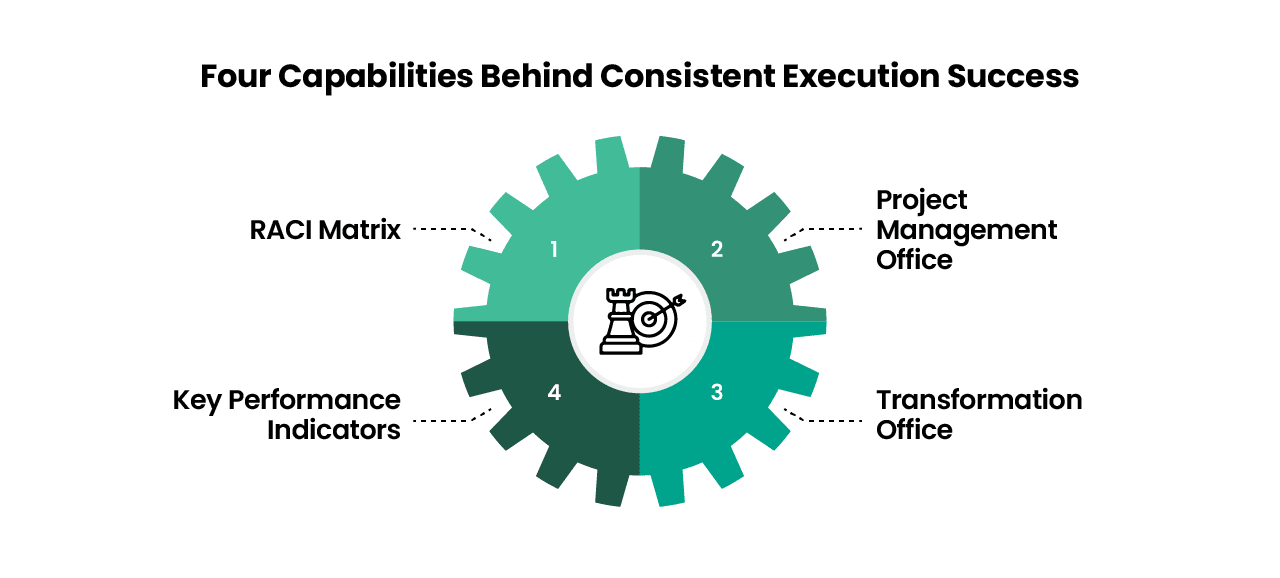
Organisations that consistently execute their strategies do not rely on enthusiasm or good intentions. They build systems that create clarity, discipline, and accountability throughout the execution journey. While every organisation is different, four capabilities consistently distinguish those that translate strategy into results from those that struggle to move beyond planning.
-
RACI Matrix
Execution begins with clarity. Every strategic initiative should have clearly defined responsibilities that leave no ambiguity about who is responsible for delivery, who is accountable for the outcome, who should be consulted, and who needs to be kept informed. A RACI matrix provides this clarity by assigning decision rights and ownership across every major initiative.
When accountability is clearly defined, decision-making becomes faster, duplication is reduced, and leaders have greater confidence that strategic priorities are progressing as intended. Without this clarity, responsibility becomes diffused and execution quickly loses momentum.
-
Project Management Office
A Project Management Office provides the governance needed to coordinate strategy execution across multiple initiatives. It establishes consistent project management practices, monitors progress, manages risks, and provides leadership with timely information on delivery performance.
Research by the Project Management Institute shows that organisations with stronger project management capabilities experience significantly better project outcomes and reduce the value lost through poor execution. More importantly, a well-functioning PMO creates visibility across the organisation, enabling leaders to identify emerging risks early and intervene before delays become business problems.
-
Transformation Office
Some strategies require more than effective project delivery. They require fundamental organisational change. Whether the objective is digital transformation, business expansion, operating model redesign, or cultural change, organisations need a central function to maintain strategic alignment and sustain momentum across the enterprise.
A Transformation Office fulfils this role by coordinating initiatives that cut across business units, resolving barriers that individual project teams cannot address, and ensuring that transformation delivers measurable business value rather than isolated project outputs. Its focus is not simply on completing activities but on realising strategic outcomes.
-
Key Performance Indicators
Execution improves when progress can be measured objectively. Well-designed Key Performance Indicators translate strategic priorities into measurable outcomes that enable leaders to monitor performance, identify gaps, and make informed decisions.
The most effective KPIs focus on outcomes rather than activity. Revenue growth, customer satisfaction, operational efficiency, digital adoption, employee productivity, and market expansion provide a clearer picture of strategic progress than the number of meetings held or reports submitted. When KPIs are embedded into leadership reviews and performance discussions, they reinforce accountability and keep strategy firmly connected to everyday decision-making.
Together, these capabilities form the foundation of an effective execution system. They create the governance, accountability, coordination, and performance discipline that enable organisations to move from strategic intent to measurable business results.
What High-Performing Organisations Do Differently
Successful organisations do not execute strategy by chance. Regardless of their industry or geography, they share a common approach. They build execution into the way they operate rather than treating it as an activity that follows strategic planning.
Microsoft provides a compelling example. Its transition from a Windows-centred software company to a cloud-first and AI-driven organisation was not achieved through strategy alone. The company aligned leadership around a clear strategic direction, invested in new capabilities, embedded performance measures, and maintained disciplined oversight of transformation. According to Microsoft’s 2025 Annual Report, these efforts contributed to revenue growth of 15 per cent, operating income growth of 17 per cent, and Azure revenue exceeding 75 billion dollars for the first time.
A similar pattern can be seen at Access Bank. Its ambition to become Africa’s most respected bank required far more than a strategic vision. The bank strengthened governance, managed post-merger integration, streamlined its operating structure, expanded into new markets, and maintained a consistent leadership focus on execution. Strategic intent was translated into coordinated action through structured programme management, clear accountability, and continuous performance monitoring.
MTN Nigeria’s evolution from a traditional telecommunications operator into a technology and platform business reinforces the same lesson. Its growth in data, fintech, enterprise solutions, and digital services was supported by disciplined execution that aligned investment decisions, organisational capabilities, customer priorities, and performance management with its long-term strategy.
Although these organisations operate in different sectors, their success reflects the same underlying principle. They treated execution as an organisational capability rather than a project. They established clear governance, assigned accountability, consistently measured performance, and invested in the capabilities required to sustain change over time. Their experience demonstrates that sustainable competitive advantage is created not only by making better strategic choices but also by building stronger execution systems.
Conclusion
The organisations that succeed in today’s increasingly complex and competitive environment are not necessarily those with the boldest strategies. They are the ones that have developed the organisational capability to execute with consistency, discipline, and agility.
Strategy should never be viewed as a document that marks the end of the planning process. It should become the management system that shapes decisions, aligns resources, drives accountability, and measures performance across the organisation. When execution becomes embedded in the way an organisation operates, strategy moves beyond aspiration and becomes a source of sustained competitive advantage.
For leaders, the challenge is no longer simply to develop better strategies. It is to build stronger execution systems that translate strategic intent into measurable business outcomes.
At pcl., we partner with organisations across the public and private sectors to bridge this gap. Through strategy design, transformation management, governance advisory, Project Management Offices, and performance management frameworks, we help organisations build the structures, capabilities, and accountability needed to turn strategy into sustainable results.
Author
Chelsea Mogboruko