
How Organisations Can Harness Artificial Intelligence Without Losing Human Intelligence
Introduction
Artificial Intelligence has moved from the periphery of corporate curiosity to the centre of global business strategy with remarkable speed. According to the IBM 2024 Global AI Adoption Index, 42% of enterprises worldwide are actively deploying AI in their business operations, while a further 40% are experimenting with it, meaning over 80% of global enterprises are already engaged with the technology in some capacity. Generative AI tools have democratised capabilities once reserved for specialist teams, enabling virtually any employee to synthesise research, draft complex documents, generate code, or analyse data within minutes.
Yet amid this accelerating adoption, a dangerous misconception is taking hold: that AI can replace human intelligence rather than enhance it. The truth is more nuanced and more urgent. While AI can process information at speeds no human team can match, it lacks the judgment, contextual awareness, ethical reasoning, and organisational intuition that distinguish genuinely effective decision-making. As reliance on AI deepens across the enterprise, organisations face three interlocking risks. The first is data exposure, the second is cognitive atrophy, and the third is unchecked AI error. Each of these risks can erode the very competitive advantage for which AI was deployed. The organisations that will thrive in the AI era are not those that deploy the most tools. They are those who deploy the right tools, with the right safeguards, within a culture where human intelligence remains the final authority.
The Rise of AI and Its Hidden Risks
The speed of AI integration into corporate life has few historical precedents. AI is now embedded across financial services, healthcare, manufacturing, and professional consulting, transforming workflows at every level of the enterprise. Tasks that once required hours of skilled human effort, such as market research, report drafting, data modelling, and code debugging, can now be completed in minutes.
This productivity shift, however, has introduced a category of risk that many organisations have been slow to acknowledge. Unlike traditional enterprise software, most AI tools actively encourage users to input detailed contextual information to generate useful outputs. In practice, this means employees routinely share strategic business plans, financial forecasts, customer databases, legal documents, source code, and confidential contracts with external AI systems, often via personal accounts that bypass enterprise security controls. According to LayerX Security’s Enterprise AI and SaaS Data Security Report 2025, approximately 77% of employees share sensitive company data via generative AI tools, with more than half of those interactions involving confidential material. Critically, 82% of the copy-paste comes from unmanaged accounts, outside any enterprise oversight, rendering standard enterprise security controls ineffective.
The consequences of this exposure were made concrete in April 2023, when Samsung semiconductor engineers leaked proprietary source code, test sequences, and internal meeting notes into an AI chatbot across three separate incidents within fewer than 20 days after the company permitted the use of AI tools. The engineers had no malicious intent; they were attempting to debug code and improve efficiency. Yet the outcome was functionally identical to a deliberate breach. Confidential intellectual property left the controlled corporate environment with no means of retrieval. Samsung responded by banning the AI tool company-wide, but the proprietary information was already beyond its reach (CIO Dive, 2023). The lesson was unambiguous. Convenience without governance is liability.
Data Is the New Crown Jewel
The financial stakes of inadequate AI governance are not abstract. The IBM 2025 Cost of a Data Breach Report places the global average cost of a data breach at $4.44 million. Where breaches involve unmanaged AI use, the average additional cost rises by $17.9 million (Sprinto, 2025). These figures span direct financial losses, regulatory penalties, litigation exposure, reputational damage, customer attrition, and operational disruption, consequences that compound over months and years after an initial incident.
What has changed in the AI era is not merely the scale of potential loss but the nature of the exposure. In the pre-AI enterprise, breaches typically required a malicious actor to penetrate defended perimeters. Today, breaches can occur when a well-meaning analyst pastes a client proposal into a chatbot or a developer uploads source code to seek debugging assistance. Verizon’s 2025 Data Breach Investigations Report found that 15% of employees routinely accessed generative AI systems on corporate devices, creating a persistent, largely invisible vulnerability that traditional security tools are not designed to detect. Data security is no longer purely an IT concern. It is a board-level strategic priority, and every employee who touches an AI system has become, knowingly or not, a steward of corporate intelligence.
The Cognitive Atrophy Threat
Beyond data exposure lies a subtler risk: the erosion of human critical thinking. While earlier technologies reduced manual effort, AI can reduce cognitive effort itself, raising concerns about how sustained reliance may weaken independent analysis.
Recent research reinforces this concern. A 2025 study by Microsoft Research and Carnegie Mellon University found that workers who trusted AI more applied less critical scrutiny to its outputs. Similarly, MIT Media Lab research found lower brain connectivity among AI-assisted writers, while a study of 54 participants linked frequent AI use to weaker critical-thinking performance.
In organisations, this cognitive offloading can gradually weaken judgment when employees accept AI-generated outputs without questioning assumptions, checking sources, or applying professional expertise. The danger is not that people use AI, but that they become less able to think independently without it.
When AI Sounds Right but Is Wrong
A third risk is AI hallucination, confident, well-written output that is inaccurate, unsupported, or fabricated. This is especially dangerous in corporate settings because AI errors often look credible until someone verifies them.
The risk is already visible. In 2026, major professional services firms reportedly withdrew or corrected AI-related reports after errors were identified, including one cybersecurity report in which 16 of 27 cited sources were found to be fabricated, misattributed, or invalid. The issue was not the use of AI itself, but weak human validation before publication.
The principle is simple: AI outputs are draft intelligence, not final intelligence. Any statistic, citation, regulation, recommendation, or client-facing claim generated by AI must be checked against reliable sources and reviewed by accountable professionals before it informs a decision.
Building a Responsible AI Framework
The path forward for organisations is not to retreat from AI. It is to deploy it with the discipline its power demands. A Responsible AI Framework built on five reinforcing pillars provides the architecture for doing so effectively and sustainably.
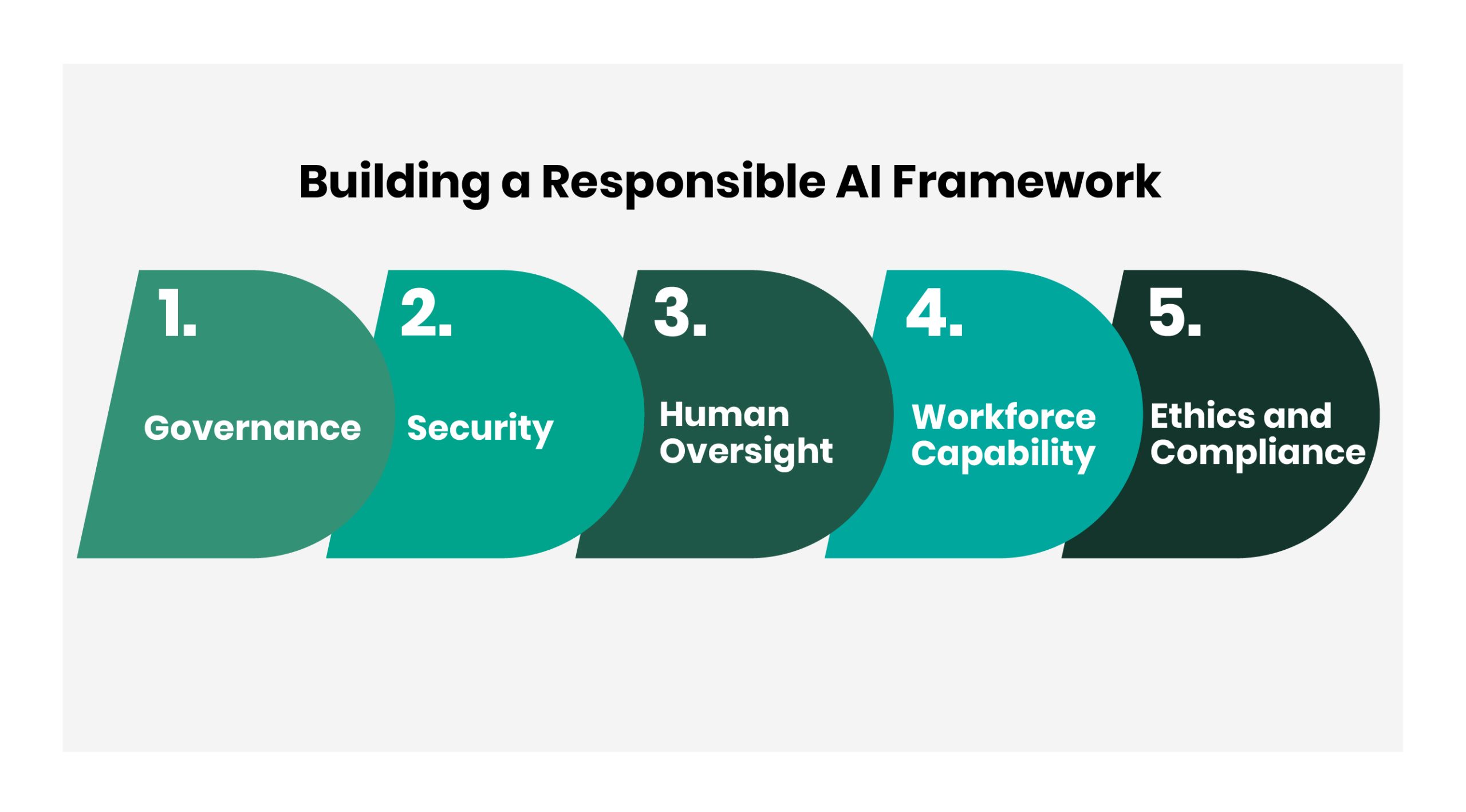
Governance: Governance is the foundation. Organisations need formal, enforced policies that define which AI tools are approved, which use cases are permitted, how corporate data must be classified before being shared with AI systems, and what accountability mechanisms apply when the policy is breached. Governance must be treated as a strategic function requiring the active engagement of senior leadership, legal, compliance, and business unit leaders working in concert. The Samsung incident demonstrates precisely what happens in its absence. A vacuum of governance will always be filled by employee convenience.
Security: Policy must be supported by technical controls. Data classification frameworks help employees understand the boundaries of acceptable AI use. Access controls and monitoring mechanisms limit and track AI interactions involving sensitive information. Enterprise-grade AI environments that process data within secure, audited infrastructure rather than public cloud platforms significantly reduce the risk of inadvertent disclosure. Security architecture in the AI era must be designed around the reality that the insider threat is no longer primarily malicious. It is well-intentioned but ungoverned.
Human Oversight: Every high-impact AI output, whether it takes the form of a strategic report, a financial analysis, a legal summary, or a published thought leadership piece, must pass through mandatory human review before it is acted upon or distributed. The pattern of AI-generated reports containing fabricated citations and inaccurate claims, as seen in the 2026 cases referenced earlier, underscores the cost of inadequate oversight. Organisations that treat AI outputs as finished products rather than as inputs to a human validation process expose themselves to reputational, financial, and legal consequences that far outweigh the efficiency gains that motivated AI adoption.
Workforce Capability: Technology governance is only as effective as the people responsible for implementing it. Organisations must invest in building genuine AI literacy across the workforce, encompassing not only the ability to use AI tools but also the critical-thinking discipline to question, evaluate, and override AI outputs when necessary. Training must address prompt engineering, data privacy principles, verification techniques, and the cognitive habits required to sustain independent analytical rigour in an AI-augmented environment. The research from MIT and Microsoft cited in this article makes the case plainly. Without deliberate investment in maintaining human cognitive capability, the expertise that makes AI valuable will itself atrophy.
Ethics and Compliance: AI use must align with applicable regulatory requirements, organisational values, and sector standards. Across Africa and globally, regulatory attention to AI governance is intensifying, and organisations that establish robust internal ethical frameworks today will be better positioned as formal regulation continues to evolve. Ethics in AI is not a constraint on innovation. It is the foundation of the trust upon which sustainable innovation depends.
The New Competitive Advantage
The most important reframing available to organisational leaders today is this. The future of work is not a contest between humans and machines. It is a partnership, and the organisations that understand this distinction earliest will secure a durable and defensible competitive advantage. AI excels at speed, scalability, and pattern recognition across vast, complex datasets. Human intelligence is exceptional at creativity, judgment, empathy, ethical reasoning, leadership, and navigating ambiguity with wisdom rather than calculation. These are not competing capabilities. They are complementary, and organisations that deliberately combine them will outperform those that treat AI adoption as an either-or proposition.
A 2025 Pew Research Centre survey found that 53% of respondents believed AI would worsen creative thinking ability, and 50% said it would weaken meaningful relationships at work. These figures reflect a widely shared intuition that something irreplaceable is at stake in the transition to AI-augmented work. Forward-thinking leaders must take that intuition seriously, not by slowing AI adoption, but by ensuring that the human capabilities AI cannot replicate are deliberately protected, developed, and invested in alongside it. The leaders who will define the next decade of organisational performance are not asking how AI can replace their people. They are asking how AI can help their people do what only humans can do, better and with greater impact.
Keeping Humans at the Centre of Intelligence
As organisations accelerate their AI adoption, the greatest risk may not be the technology’s known limitations. The greatest risk may be the human temptation to surrender judgment to systems that have none. The corporate data leaks, the retracted AI-generated reports, the fabricated citations presented to the public under the banner of authoritative research, these are not cautionary tales about AI being dangerous. They are cautionary tales about the absence of governance. In each case, the technology functioned exactly as designed. It was human oversight, the review, the validation, the deliberate act of critical scrutiny, that was missing.
Responsible AI is not simply a compliance function. It is an organisational philosophy, a commitment to preserving the judgment, creativity, accountability, and ethical reasoning that no machine can supply, and that every high-performing enterprise depends upon. The organisations that will lead in the years ahead are those that combine the efficiency of artificial intelligence with the wisdom of human intelligence, ensuring that technology supports decision-making while human judgment remains the final and irreplaceable authority. Competitive advantage in the AI era will not be determined by who has the most AI. It will be determined by who uses AI most responsibly.
Phillips Consulting (pcl.) supports organisations in adopting AI responsibly through AI governance framework design, data privacy and cybersecurity strengthening, AI risk assessments, and workforce capability development. For more information, contact enquiries@phillipsconsulting.net
Author
Abraham Irediran