
Introduction
Picture a mid-sized Nigerian bank undergoing rapid digital transformation. Over the past few years, it has automated parts of its loan-processing operations, introduced chatbot-assisted customer service, and deployed AI-enabled fraud-monitoring systems. Transaction speeds have improved, operational costs have reduced, and service delivery has become more efficient. Yet internally, a different concern is emerging. Employees whose responsibilities were previously centred on processing, verification, and administrative review are discovering that many of their traditional functions are evolving faster than their skills can adapt.
This reality is increasingly visible across emerging sectors. From banking halls and manufacturing plants to hospitals and public sector institutions, automation is changing how work is organised, how decisions are made, and which capabilities organisations now consider valuable. The scale of this transformation is significant. Advances in artificial intelligence, workflow automation, robotics, and data analytics are accelerating the restructuring of routine and process-driven work across industries.
According to the World Economic Forum’s Future of Jobs Report 2023, nearly half of employees’ core skills are expected to be disrupted within the next five years. For emerging economies such as Nigeria, where workforce expansion, youth unemployment, and institutional capability gaps remain pressing concerns, the implications extend far beyond technology adoption alone.
Organisations that will succeed in the future of work are unlikely to be those that pursue automation in isolation. More sustainable outcomes will emerge from institutions that align technology adoption with deliberate workforce transformation strategies, balancing productivity, operational efficiency, workforce resilience, and long-term organisational adaptability.
This article presents a quantitative framework for assessing organisational readiness amid automation-driven transformation. It examines how automation is reshaping key sectors, including banking, manufacturing, healthcare, and the public sector, and identifies practical priorities for business leaders and policymakers seeking sustainable transformation in emerging economies.

How Automation Is Reshaping Tasks, Roles and Workforce Structures
Understanding automation’s impact requires moving beyond job titles to the task level, where most roles consist of bundles of activities with varying degrees of automation susceptibility. AI and robotics typically automate specific tasks rather than entire roles, reshaping job design rather than eliminating work wholesale. As routine tasks are automated, responsibilities increasingly shift toward judgment, collaboration, and oversight of automated systems.
Task-Level Transformation
Tasks that are repetitive, rules-based, and data-structured are typically the first to be automated: data entry, financial reconciliation, standard reporting, identity verification, and routine customer queries. By contrast, tasks that require contextual judgement, creativity, emotional attunement, or ethical reasoning are significantly more resistant to automation.
The cumulative effect of task-level automation is a structural shift in how work is distributed across organisations. Three consistent patterns are emerging across industries and geographies:
- Declining demand for routine execution: Roles centred on processing, verification, and rule-based decision-making are contracting. These are often the entry-level roles that have historically served as the first rung of the career ladder, particularly in banking, insurance, and public administration.
- Rising demand for human-machine collaboration skills: As automation systems become embedded in core operations, the ability to work alongside, interpret, and oversee technology outputs is becoming a baseline requirement across a wide range of roles, not just technical functions.
- Concentration of value in judgment-intensive work: The roles most protected from automation and most rewarded in the labour market are those requiring critical thinking, complex problem-solving, ethical reasoning, and interpersonal leadership. Organisations that can develop these capabilities internally will hold a significant competitive advantage.
For organisations in emerging sectors, this structural shift presents both risk and opportunity. The risk lies in allowing large cohorts of employees to become stranded in roles that are gradually being hollowed out by automation. The opportunity lies in proactively redeploying human capacity into higher-value work, using the efficiencies created by automation as a catalyst for workforce redesign and capability development.
How Automation Is Affecting Key Sectors and the Capabilities Organisations Now Need
A closer look at four key sectors in emerging markets reveals how automation is reshaping work and the capabilities organisations now need to remain competitive.
Public Sector: The rapid digitisation of the public sector in emerging markets spans identity management, taxation, business licensing, and citizen services. India’s Aadhaar program exemplifies this trend, having cut administrative costs by over USD 12 billion since its launch and increasing demand for digital governance experts (UIDAI, 2023).
Conversely, Nigeria faces greater hurdles in deploying these digital tools due to civil service rules, union influence, and staffing-related political issues. This highlights the importance of strategic change management in ensuring successful digital transformation, which requires more than technical upgrades. Key skills now include data stewardship, designing citizen interactions, fostering inter-agency cooperation, and building governance frameworks to ethically and equitably oversee automated services.
Banking & Financial Services: Banking in emerging markets has seen rapid and extensive automation compared with many other sectors. Back-office tasks, fraud detection, credit assessments, and customer support are all undergoing major changes. For example, JPMorgan Chase has integrated AI into compliance and risk management, leading to clear efficiency gains (JPMorgan Chase Annual Report, 2022).
Similarly, Nigerian commercial banks, which employ about 100,000 people (CBN Annual Report, 2023), are following this trend. The impact on the workforce is already evident, as the demand for skills in data analytics, cybersecurity, and digital products is rising swiftly, while traditional processing and transactional jobs are declining. This creates an urgent need for reskilling, especially given the limited external supply of digital talent.
FMCG & Manufacturing: Smart factory technologies, including advanced robotics, predictive maintenance, and the industrial Internet of Things, are transforming manufacturing worldwide. Companies such as Siemens use real-time data to improve uptime and reduce waste. Nigeria’s manufacturing industry, which accounts for about 12% of GDP (National Bureau of Statistics, 2023), is gradually adopting these innovations despite hurdles such as variable input costs and intense competition. For FMCG firms, automation is also reshaping demand forecasting, inventory management, and logistics, increasing the need for professionals who combine operational knowledge with data literacy, skills that are rare today.
Healthcare: Healthcare has a highly complex automation profile: clinical judgment, patient empathy, and ethical reasoning are inherently human traits, making automation mostly complementary rather than replacement. At Mayo Clinic, AI-powered diagnostic tools have significantly improved speed and accuracy, enabling clinicians to focus more on complex cases and patient relationships (Mayo Clinic Proceedings, 2022). This hybrid approach is increasingly becoming the norm in top-performing health systems worldwide.
For Nigerian healthcare facilities, where the patient-to-clinician ratio already strains capacity, automation offers a valuable opportunity to expand the reach of current clinical staff without requiring significant increases in personnel. However, this requires deliberate investment in clinical data literacy, enabling staff to interpret AI insights, scrutinise their outputs, and use them effectively during patient care.
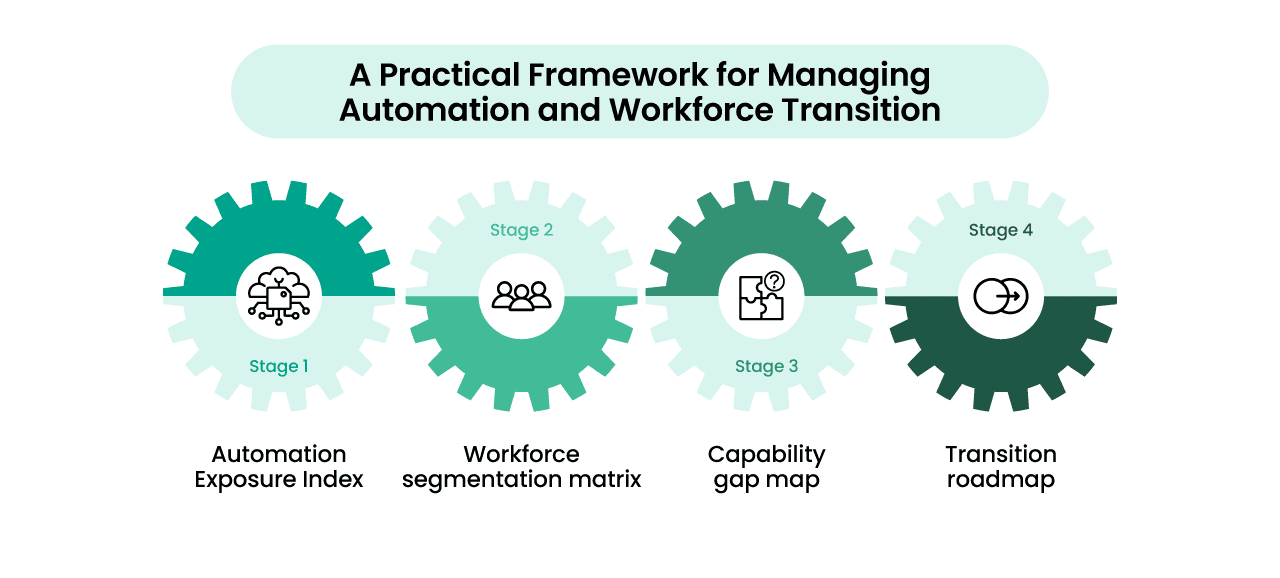
A Practical Framework for Managing Automation and Workforce Transition
Understanding that automation is reshaping work is only the starting point. Organisations require a structured approach to identifying workforce exposure, redesigning roles, and preparing employees for evolving operational realities. A practical framework for automation and workforce transition can therefore be organised into four interconnected stages.
Stage 1: Automation Exposure Index
The first step is to understand which tasks and functions are most susceptible to automation. This requires organisations to assess roles at the task level, evaluating the extent to which activities are repetitive, rule-based, data-driven, or dependent on human judgement and interpersonal interaction.
Stage 2: Workforce segmentation matrix
Once exposure levels are understood, organisations can categorise roles based on their automation impact. Some functions are highly exposed and likely to require significant redesign or redeployment, while others will become augmented through human and technology collaboration. Certain roles will remain fundamentally human-centred because they rely heavily on leadership, creativity, ethical judgment, or relationship management.
Stage 3: Capability gap map
As roles evolve, workforce capability requirements must evolve alongside them. Effective reskilling goes beyond generic digital training and focuses on helping employees transition into redesigned roles with new technical, analytical, and problem-solving competencies. For many organisations, particularly in emerging economies where specialised talent supply remains limited, internal capability development is often more sustainable and cost-effective than external replacement hiring.
Stage 4: Transition roadmap
The final stage involves translating workforce insights into long-term strategic decisions. Organisations must determine whether automation will primarily be used as a cost-reduction mechanism or as a broader transformation strategy aimed at improving productivity while retaining and redeploying human capacity
Practical Priorities for Business Leaders and Policymakers
The following priorities reflect what that discipline looks like in practice, for both business leaders and the policymakers who shape the environment in which they operate.
Building the Capability to Lead Workforce Transition
The urgency is real, but so is the opportunity. Leaders who move now, before skills gaps widen into capability crises, will be positioned to extract the full strategic value of automation rather than managing its fallout.
Business leaders should take a proactive, strategic approach to workforce transition by assessing how automation will affect roles and tasks across the organisation. Technology investments should be aligned with workforce development so organisations can not only adopt new systems but also equip employees with the skills needed to succeed in changing operating models.
Instead of defaulting to workforce replacement, organisations should focus on reskilling employees and redesigning roles to support stronger collaboration between human expertise and AI capabilities. This approach helps retain institutional knowledge, maintain employee morale, and maximise the value generated through effective human-AI integration. To sustain this over the long term, workforce transitions should be overseen at the executive and board levels, with clear accountability for tracking skills development and adjusting strategy as technology continues to evolve.
Creating the Enabling Environment for Sustainable Workforce Transformation
Business leaders cannot manage this transition alone. Policymakers play a central role in determining whether automation-driven workforce change leads to inclusive growth or widening inequality. Education systems must be restructured to prioritise digital literacy, data fluency, and human-machine collaboration, while vocational and tertiary institutions are aligned more closely with evolving industry needs.
Beyond education, governments need to strengthen workforce transition systems, including reskilling programmes, portable skills credentials, labour-market intelligence, and career mobility support. Public-private collaboration is also essential to ensure policy keeps pace with technological change and supports both productivity growth and job creation.
Conclusion
The divide between technology implementation and workforce strategy is a choice that can be addressed, not an unavoidable fact. Organisations that effectively manage automation will view reskilling as a strategic investment, treat role redesign as a core organisational capability, and prioritise workforce transition planning at the board level. They will aim for both productivity gains and workforce sustainability with equal focus.
For emerging economies such as Nigeria, the risks are higher, and there is less margin for error. However, there is also an opportunity to build organisations that harness the productivity gains of intelligent automation while equipping their workforce to thrive alongside it. At Phillips Consulting Limited, we are convinced that the future belongs to organisations that act quickly, leveraging both their people and technology.
Is Your Organisation Ready for the Future of Work?
To learn how our Workforce & Digital Transformation Practice can support your automation and workforce strategies, email us at enquiry@phillipsconsulting.net
Author
Abraham Irediran