
For Nigerian leaders in 2026 and beyond, leadership is no longer about managing stability; it is about sustaining performance under continuous disruption. Currency volatility is compressing organisational budgets, talent migration is weakening institutional memory, regulatory shifts are accelerating unpredictably, and AI systems are rapidly automating functions once considered core human work. In this environment, organisational survival is increasingly determined not by size or history but by adaptability.
A learning mindset is what separates organisations that absorb disruption from those that collapse under it. It is not a training function or HR initiative, but a leadership capability that enables continuous reinterpretation of change, rapid redeployment of talent, and ongoing redesign of work structures as conditions evolve.
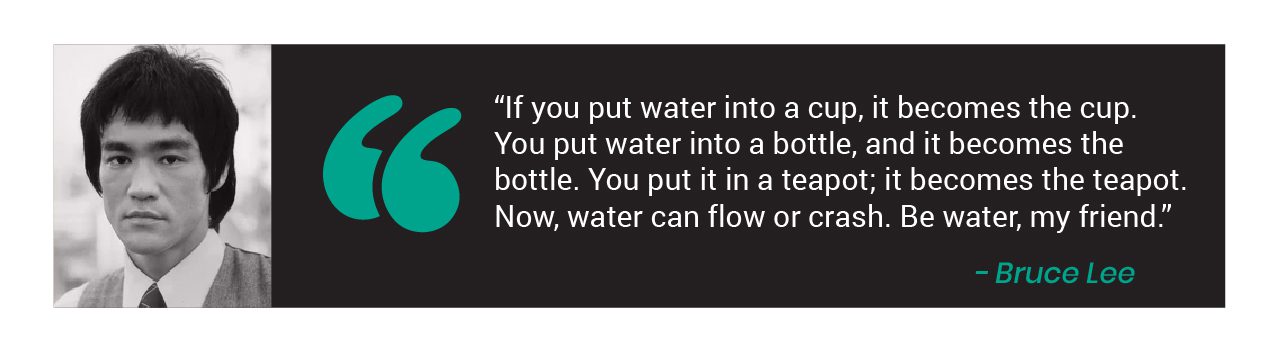
This idea is captured in Bruce Lee’s philosophy, which explains that water has no fixed form; it adapts to whatever container it enters, whether a cup, a bottle, or a teapot, and can flow or crash depending on the context. In the same way, organisations that thrive in volatility are those that do not rigidly preserve structure but instead develop the ability to reshape themselves in response to shifting realities.
For instance, in the telecommunications sector, AI has begun handling a significant share of customer service interactions. Some organisations responded by reducing headcounts. Others treated it as a redesign opportunity, redeploying staff into data analytics, customer experience design and digital revenue roles. The difference lies not in technology adoption but in leadership’s interpretation of capability.
This article will examine how a learning mindset functions as a core operating capability for organisations navigating sustained disruption in Nigeria. It will show why traditional approaches to training and workforce development are no longer sufficient and how the real differentiator lies in the speed at which organisations convert learning into redeployment and structural change. It will also illustrate how leading organisations are already reshaping roles, processes, and talent pathways to remain competitive in environments defined by volatility rather than stability.
Why Learning Mindset Leadership Determines Organisational Speed
Across sectors, the gap between leading and lagging organisations is no longer primarily about strategy or access to resources. It is about how quickly organisations can interpret change and translate it into execution. Two firms may see the same signal, whether a regulatory shift, a change in customer behaviour, or a new technology, but the one that acts faster captures disproportionate value.
This is where many organisations struggle. Their structures are designed for stability, with layered approvals, fixed roles, and periodic decision cycles. These systems create internal friction that slows down response, even when leadership recognises the need to act. Over time, this lag compounds, turning small delays into lost opportunities, missed revenue, and declining relevance.
A learning mindset changes this dynamic by enabling continuous adjustment. It allows organisations to move from episodic change to ongoing recalibration, where talent, processes, and priorities can be realigned in near real time. The result is not just adaptability, but operational speed.
This distinction becomes critical in the current Nigerian context. In financial services, product cycles are compressing, and new entrants are redefining customer expectations. In consumer markets, smaller players are testing and iterating faster than established brands. In technology-driven sectors, automation is reshaping roles faster than traditional workforce planning cycles can keep up. In each case, the organisations that gain an advantage are those that can act on insight without delay.
The implication for leadership is clear. A learning mindset is not important because it encourages development, but because it determines whether the organisation can keep pace with its environment. Without it, even well-resourced organisations become structurally slow, and in a fast-moving market, structural slowness translates directly into competitive loss.
The Real Cost of Organisational Lag in a Fast-Changing Market
The absence of a learning mindset shows up as organisational lag. This lag carries direct and measurable business consequences:
- Delayed response to market signals: Organisations constrained by long approval cycles and rigid planning windows respond after opportunities have narrowed or disappeared. Evidence from the Strategic Management Journal shows that firms with faster strategic decision-making consistently outperform slower peers in growth and profitability, particularly in high-velocity environments.
- Revenue loss from slow execution and resource reallocation: In fast-changing markets, value accrues to organisations that move capital and talent early. Research on internal capital markets from institutions such as Columbia University shows that firms can rapidly reallocate resources to achieve higher productivity and returns, while slower reallocation suppresses value creation.
- Talent attrition and capability drain: High-performing employees prioritise environments where they can learn and apply new skills quickly. Data from LinkedIn’s 2025 Workplace Learning Report indicates that a lack of growth and mobility is a primary driver of attrition. In slow organisations, bureaucracy replaces momentum, and top talent exits for faster-moving environments.
- Reduced innovation output: Innovation is not just about investment; it is about speed of iteration. Data from the World Intellectual Property Organisation shows that organisations with faster experimentation cycles convert ideas into products and processes more quickly. Slow execution increases time-to-market and reduces the likelihood that ideas scale.
- Inability to capture value from technology investments: A 2025 global study by Harvard Business Impact finds that leadership learning speed is a key determinant of successful technology adoption. When leaders lag in capability, digital investments, including AI, fail to translate into operational or strategic value.
- Erosion of competitive position: Research from the OECD shows that firms with faster adaptability and resource reallocation gain market share over less responsive competitors. In volatile environments, slower organisations are not just outperformed; they are displaced.
Practical Ways Leaders Demonstrate a Learning Mindset in Daily Work
Below are practical ways leaders can embed and demonstrate a learning mindset in their day-to-day leadership:
-
Set visible, measurable learning goals tied to business realities
Learning should not sit in HR dashboards. Leaders should define personal learning goals that are visible, time-bound, and linked to real business pressures. For instance, a leader might commit to understanding FX exposure modelling using tools such as Power BI or Python within a defined period to reduce reliance on delayed reporting cycles. When leaders openly communicate such goals, they signal that learning is operational, not symbolic.
A widely cited example is the Late Herbert Wigwe, former CEO of Access Bank, who was widely recognised for prioritising talent development, mentorship, and continuous learning within the organisation. His leadership reinforced the idea that learning is a strategic priority driven from the top, rather than delegated.
-
Actively seek feedback and apply it publicly
Leaders should regularly request feedback from teams, peers, and stakeholders, and more importantly, demonstrate how that feedback informs decisions. When leaders respond visibly to input, it normalises learning as part of execution rather than criticism. It also reduces the fear of experimentation within teams, because learning becomes expected rather than penalised.
-
Recognise progress, not just outcomes
In fast-moving environments, waiting for results before recognising effort discourages experimentation. Leaders should intentionally acknowledge incremental improvements such as process efficiency gains, faster turnaround times, or early-stage experiments that reduce future risk.
These signals reinforce that learning and iteration are valued behaviours, not just final deliverables. This is particularly important in volatile contexts where outcomes are often delayed or externally influenced. Recognition must therefore extend to progress, not only success.
-
Encourage structured exposure to diverse perspectives
Learning accelerates when teams are exposed to different ways of thinking. Leaders should actively create opportunities for cross-functional collaboration, external engagement, and customer immersion. This could include inviting external experts, rotating team members across functions, or embedding customer feedback directly into decision cycles. The goal is to reduce internal echo chambers and improve decision quality through broader input.
In leadership terms, this becomes a capability for better judgment in uncertain situations.
Cultivating a Culture of Resilience and Adaptability
A learning mindset is often blocked not by awareness, but by organisational and psychological constraints. Addressing these barriers is essential to building adaptive organisations.
- Fear of failure: Leaders often avoid experimentation due to the risk of error. This limits learning velocity. The corrective approach is to explicitly treat failure as input for iteration rather than as performance collapse, especially in innovation or transformation initiatives.
- Attachment to existing systems: Familiar processes often persist long after they lose relevance. Leaders must intentionally challenge legacy practices and prioritise redesign over comfort with the status quo.
- Fear of appearing uninformed: Many leaders avoid asking questions to maintain authority. Visible curiosity strengthens leadership credibility and reinforces organisational learning behaviour.
- Lack of time for learning: Learning is often deprioritised in favour of execution. However, in fast-changing environments, reflection and learning are not separate from execution; they are what make execution effective over time.
Conclusion
Being “water” in a Nigerian leadership context is not passivity; it is adaptive execution. It means leaders engage new tools before mandating adoption, share learning before celebrating outcomes, and model adaptation in real time so teams can mirror that behaviour without fear.
The real question for leaders is no longer whether disruption will continue, but whether their organisations can adapt fast enough to remain relevant within it. In many cases, the gap between environmental change and organisational response is where competitive advantage is lost. The leaders who close that gap will not only sustain their organisations but also define the next phase of African enterprise.
Author
Aderonke Ayoade