
Why currency strength is central to reducing inflation and restoring macroeconomic balance
Nigeria’s economy in 2026 remains under significant cost pressure, even though annual inflation has moderated compared with the previous year. Headline inflation eased to 15.06% year on year in February 2026, then rose again to 15.93% in May 2026, suggesting that disinflation remains fragile rather than firmly established. Food inflation also remained a central pressure point, rising to 12.12% year on year in February 2026 and continuing to shape household purchasing power and business cost structures. For corporate leaders, policymakers, and investors, these movements reinforce the importance of exchange rate stability, energy costs, and domestic production capacity in determining Nigeria’s broader cost environment.
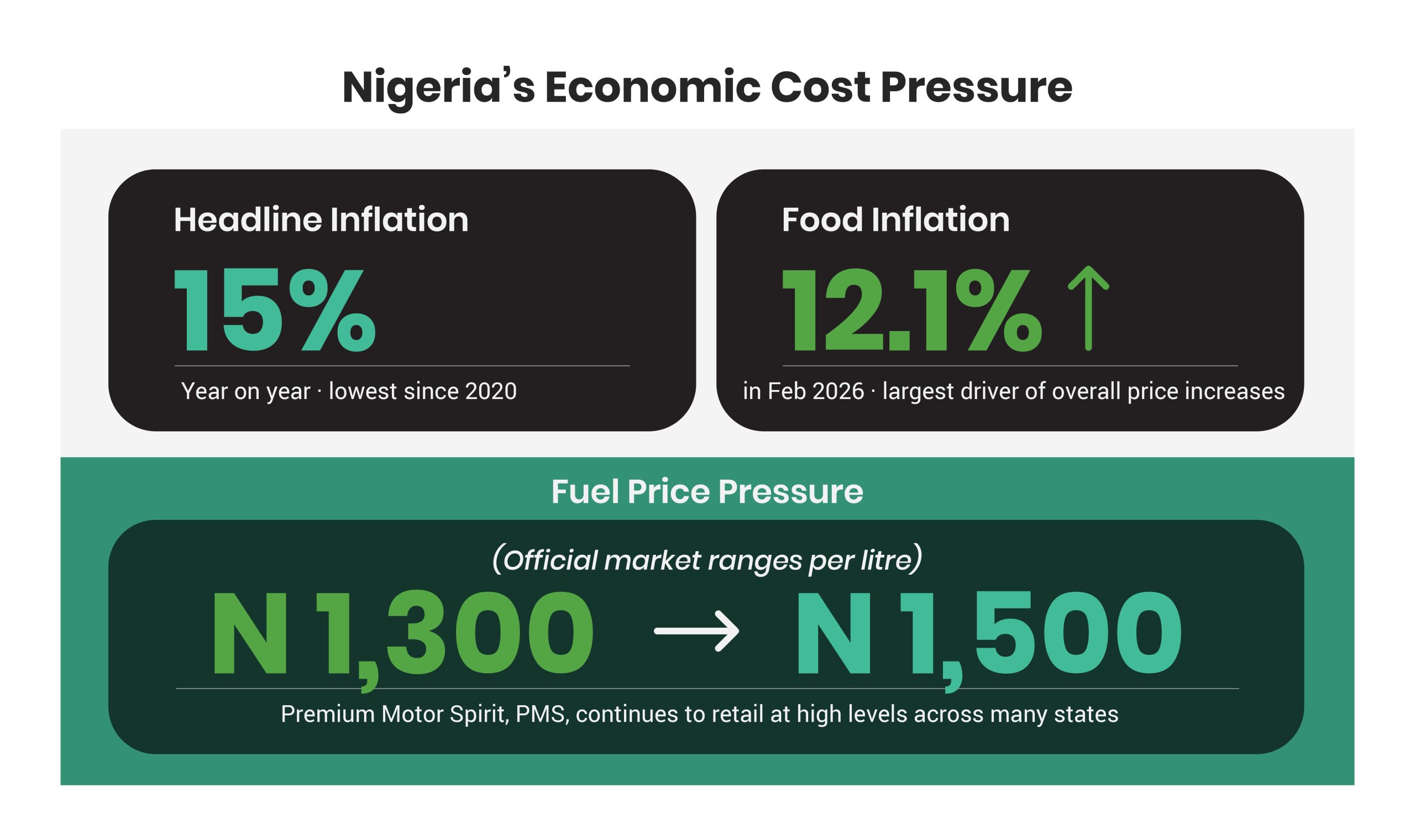
Fuel prices are a particularly acute pressure point. National Bureau of Statistics data show that the average retail price of Premium Motor Spirit, PMS, was ₦1,300 per litre in March 2026, but it rose sharply to about ₦1,500 per litre by May 2026, with state-level averages varying significantly. These sustained energy costs directly increase transport and distribution expenses and ultimately feed into consumer prices. In practical terms, filling a 45- to 50-litre fuel tank in May 2026 at the average prices would cost roughly ₦71,800 to ₦79,800, which is at or above Nigeria’s statutory national minimum wage of ₦70,000 per month. This clearly illustrates the severity of cost-of-living pressures and the widening gap between earnings and essential expenses.
The impact on businesses and households is immediate and far-reaching. Rising input costs compress margins, distort pricing strategies, and weaken investment confidence. Exchange rate volatility further complicates planning, particularly for firms reliant on imported inputs or foreign-denominated obligations. For households, living costs are steadily eroding real incomes as wage growth lags behind inflation. These pressures, while often considered separately, are deeply interconnected and mutually reinforcing.
At the centre of these dynamics lies the naira. Its relative weakness and volatility in recent years have amplified external shocks and transmitted them into domestic prices. Yet Nigeria has not always faced such conditions. In the 1970s and early 1980s, the naira traded near parity with the US dollar, supported by strong oil revenues and a less import-dependent economic structure. The subsequent shift to sustained depreciation reflects decades of structural imbalance and policy inconsistency, highlighting the currency’s central role in cost and macroeconomic stability.
This article argues that the naira’s weakness is not merely a symptom of broader economic challenges but also a major transmission mechanism through which structural weaknesses manifest as inflation, rising production costs, and broader macroeconomic fragility. It therefore seeks to establish a clear analytical link between currency strength and Nigeria’s cost structure, assess the effectiveness of ongoing reform efforts, and outline a structured policy pathway for achieving a stronger, more stable naira without triggering economic disruption.
Nigeria’s Cost Structure and the Central Role of the Naira
Nigeria’s economy is highly sensitive to exchange rate movements due to its reliance on imported goods, fuel, and industrial inputs. As a result, fluctuations in the naira have immediate and system-wide implications for pricing, production, and overall economic stability.
This relationship operates through three primary transmission mechanisms:

1. Imported inflation: Goods and services, especially fuel, machinery, and intermediate inputs, embed inflation directly into the economy.
2. Cost transmission effects: Rising input costs cascade through production and distribution chains, with manufacturers and transport operators passing costs onto consumers, resulting in broad‑based inflation.
3. Structural fragility: Repeated exchange rate shocks weaken long‑term resilience. Investment planning becomes short‑term, business confidence wanes, and reliance on imports increases.
These dynamics demonstrate that the naira is not simply a financial variable but a central determinant of Nigeria’s cost structure and macroeconomic stability.
The Pricing Illusion and Economic Burden
In nominal dollar terms, Nigeria’s fuel prices appear relatively moderate compared to those of advanced economies. However, this comparison fails to account for differences in income levels and purchasing power.
Even with a relatively low GDP per capita, modest fuel prices consume a significant share of household income in Nigeria. Currency depreciation further increases the local cost of globally priced commodities, while the economy’s reliance on fuel across transportation, agriculture, and manufacturing amplifies the overall burden.
The result is a structural imbalance where fuel appears inexpensive globally but is economically expensive domestically. This highlights a critical policy gap. Economic management often focuses on nominal price levels rather than real affordability. Without addressing currency weakness, price control measures alone cannot deliver sustainable relief.
What a Stronger Naira Would Change Structurally
A stronger and more stable naira would significantly alter Nigeria’s economic trajectory. Lower imported inflation would reduce the cost of essential goods and services, easing pressure on households and businesses. Exchange rate stability would improve investment planning, enhance business confidence, and support long-term growth.
In addition, stronger purchasing power would improve living standards, while enhanced macroeconomic credibility would attract both domestic and foreign investment. More fundamentally, a stronger naira would shift the economy from a reactive posture to a strategic one, enabling policymakers to stabilise expectations and manage growth more effectively.
Achieving a Stronger Naira Without Economic Disruption
Strengthening the naira requires a carefully sequenced strategy that balances reform with stability. Nigeria is currently undergoing a shift toward a more market-aligned FX regime, supported by exchange rate unification, tighter monetary policy, and efforts to improve formal FX inflows. These moves are reflected in the external sector.
Central Bank reporting placed external reserves at about $48.8 billion as of 20 February 2026, while the CBN Governor also referenced gross external reserves of $50.45 billion as of 16 February 2026. Taken together, these figures indicate a stronger external buffer, although reserve strength must still translate into durable liquidity, investor confidence, and exchange rate stability.
To manage this transition effectively, four operational priorities are critical:
- Expand foreign exchange supply in the short term: Nigeria is improving FX inflows through higher oil output, diaspora remittances, and portfolio investments. Emerging channels, including regulated digital-asset- and stablecoin-based remittance flows, may supplement formal inflows when properly supervised.
However, Nigeria ranked sixth globally in the 2025 Chainalysis Global Crypto Adoption Index while remaining the largest crypto market in Sub-Saharan Africa by on-chain value, so the stronger claim is not that Nigeria leads the world, but that it is a major regional crypto-adoption market. Long-term FX stability still requires resolving structural constraints in oil production, diversifying non-oil exports, and integrating all inflows into a formal, transparent system.
- Anchor market confidence during reform: Exchange rate transparency has improved, but consistency is key. Avoiding policy reversals and clearly communicating intentions will reduce speculation and stabilise market expectations.
- Manage import dependence during adjustment: Short-term measures, such as targeted import substitution in critical sectors and support for local producers, can reduce FX demand without disrupting supply chains. Long-term industrial policy remains essential to permanently lower dependence on imports.
- Maintain macroeconomic discipline: Monetary tightening and fiscal adjustments must continue to prevent excess liquidity from destabilising the naira. Close coordination between fiscal and monetary authorities is critical during this transition.
In its current phase, Nigeria is effectively in a stabilisation and transition cycle. The success of this phase will depend on whether existing reforms are sustained, coordinated, and supported by complementary measures that reduce short-term economic strain while reinforcing long-term currency strength.
Where Nigeria Stands Today: A Diagnostic Assessment of Currency Stability
Nigeria is in a transitional phase, moving from a heavily managed FX regime to a more market-aligned system. Reforms show clear policy intent, but outcomes remain mixed. Key observations include:
- External sector: FX earnings are still heavily reliant on crude oil. Non-oil exports contribute marginally, and supplementary inflows like remittances and portfolio investments remain volatile.
- FX market conditions: Rate unification has improved transparency and price discovery, but liquidity remains limited, and demand pressures persist.
- Domestic production capacity: Key sectors face infrastructure deficits, energy challenges, and limited finance access. High import dependence keeps FX demand elevated. Policy support for local production is underway, but the impact is limited.
- Macroeconomic policy environment: Tighter monetary policy and subsidy removal mark significant reform steps. Inflation remains elevated, and fiscal pressures continue.
- Social and economic resilience: Rising fuel and food costs strain households and businesses. Existing mitigation measures have limited reach, requiring careful balancing of reform momentum and social stability.
Nigeria’s current position reflects a reforming but still fragile system, where policy direction is clear but structural constraints continue to limit the pace and depth of currency stability.
Policy Framework for a Stronger and More Stable Naira
Beyond immediate stabilisation, achieving a structurally strong naira requires a comprehensive and enduring policy architecture. Unlike the transition-focused measures outlined above, this framework defines the economy’s long-term equilibrium state and the institutional conditions required to sustain currency strength.
This framework is built on five interdependent pillars:
- External sector strengthening: This pillar focuses on fundamentally improving Nigeria’s foreign exchange earning capacity. While current efforts are concentrated on restoring oil production, long-term stability depends on diversifying exports into agriculture, manufacturing, and services. The objective is to create a resilient and consistent FX inflow base that is not solely dependent on crude oil.
- Foreign exchange market deepening and reform: Nigeria has initiated exchange rate liberalisation, but deeper reforms are required to build a truly efficient FX market. This includes improving liquidity, broadening participation, strengthening regulatory oversight, and ensuring that exchange rate determination remains market-reflective and transparent over time.
- Domestic production and industrial capacity expansion: Structural demand for foreign exchange will remain high unless Nigeria significantly reduces its reliance on imports. This requires sustained investment in industrial infrastructure, energy reliability, and value chain development across key sectors, including agriculture, refining, and manufacturing.
- Institutionalised monetary and fiscal discipline: While current policies reflect tightening efforts, long-term currency strength depends on embedding discipline within institutions. This includes maintaining low and stable inflation, reducing fiscal deficits, improving revenue mobilisation, and limiting monetary financing of government expenditure.
- Embedded social resilience and adaptive reform sequencing: For reforms to be sustainable, they must be socially and politically viable. This requires institutionalising social protection mechanisms, such as targeted subsidies and income support, and ensuring that reforms are phased in to allow households and businesses to adjust.
This framework is not a set of short-term interventions but a systemic model for macroeconomic stability. Its effectiveness depends on policy continuity, institutional alignment, and the ability to maintain strategic focus beyond immediate economic cycles.
Conclusion
Nigeria’s macroeconomic instability is fundamentally linked to the weakness of the naira, which amplifies inflation, distorts cost structures, and constrains growth. Addressing this challenge requires a shift toward a coordinated, sustained strategy to strengthen the currency.
A stronger naira would reduce inflationary pressures, restore purchasing power, improve investment conditions, and support long-term economic stability. This is not a policy objective but a structural necessity.
pcl. can play a transformative role by supporting government and institutions in designing and executing integrated reform strategies. Through data-driven analysis, institutional capacity building, and implementation support, we position ourselves as strategic partners in driving reforms required to achieve a more stable and resilient Nigerian economy.
Author
Kolawole Sunday