
Introduction
Micro, Small, and Medium-sized Enterprises (MSMEs) are the foundation of economies worldwide. They account for approximately 90% of businesses globally, generate more than half of all employment, and contribute significantly to economic growth, innovation, and resilience. In Nigeria, their role is even more pronounced. With over 39 million MSMEs, the sector accounts for 96% of all businesses, employs more than 80% of the workforce, and contributes nearly half of the nation’s Gross Domestic Product.
Yet, despite their scale and significance, Nigeria’s greatest MSME challenge is no longer business creation. It is business growth. While millions of Nigerians demonstrate remarkable entrepreneurial drive, too few enterprises successfully transition from small, survival-oriented businesses into productive, competitive, and scalable organisations. The gap is no longer one of entrepreneurship but of enterprise development.
This challenge has become even more urgent as the global economy undergoes a profound transformation. Digitalisation, artificial intelligence, the African Continental Free Trade Area (AfCFTA), and changing consumer expectations are reshaping how businesses compete and create value. In this environment, entrepreneurial ambition alone is no longer enough. Sustainable growth will depend on productivity, innovation, capability, and the ability to compete beyond local markets.
Against this backdrop, MSME Day should be more than an annual celebration of small businesses. It should serve as a strategic reminder that Nigeria’s long-term economic prosperity will depend not only on creating more enterprises but on enabling existing ones to grow, innovate, and compete. Unlocking growth beyond start-up is therefore not simply an MSME agenda. It is a national economic imperative.
Nigeria’s Enterprise Challenge
Nigeria is often described as a nation of entrepreneurs, and rightly so. From the manufacturing clusters of Aba to the technology ecosystem in Lagos and the agricultural value chains across the country, entrepreneurial activity is deeply embedded in the economy. Millions of Nigerians start businesses every year, driven by opportunity, necessity, and an enduring culture of enterprise.
Yet, entrepreneurship alone does not guarantee economic transformation. The real measure of success is not how many businesses are created, but how many grow into productive, competitive, and resilient enterprises. This is where Nigeria faces its greatest challenge.
While business creation remains high, business survival and scale remain limited. According to the Small and Medium Enterprises Development Agency of Nigeria (SMEDAN), only a small proportion of MSMEs progress beyond the microenterprise stage. Many continue to operate with limited capital, informal management structures, low productivity, and restricted access to larger markets. As a result, they create livelihoods but often struggle to generate the levels of innovation, competitiveness, and value addition needed to accelerate economic growth.
Closing this gap requires a shift in perspective. Nigeria must move beyond celebrating entrepreneurship as an end in itself and focus on enterprise building. The priority is no longer simply helping more people start businesses. It is creating the conditions that enable existing businesses to scale, improve productivity, compete across borders, and contribute more meaningfully to national development.
What Holds MSMEs Back?
Several structural barriers continue to prevent Nigerian MSMEs from transitioning from start-ups to productive, competitive, and scalable enterprises.
- Access to Finance: The International Finance Corporation (IFC) estimates that Nigeria faces an MSME financing gap of approximately $158.1 billion (International Finance Corporation, 2025). High interest rates, stringent collateral requirements, and limited access to formal credit prevent many businesses from investing in expansion, technology, innovation, and workforce development.
- Infrastructure Deficits: Unreliable electricity, inadequate transport networks, and limited digital infrastructure significantly increase operating costs and reduce productivity. Rather than investing in growth, many MSMEs devote scarce resources to overcoming basic operational challenges.
- Capability and Leadership Gaps: Sustainable business growth requires more than entrepreneurial ambition. Many MSMEs lack the managerial capability, financial discipline, digital skills, and strategic leadership needed to improve productivity, attract investment, and compete in increasingly dynamic markets.
- Limited Market Access and Regulatory Burdens: Although the African Continental Free Trade Area presents significant opportunities, many Nigerian MSMEs struggle to access regional and international markets due to complex regulations, inconsistent policies, weak export readiness, and limited integration into larger value chains.
These barriers are interconnected and reinforce one another. Addressing one challenge in isolation is unlikely to unlock sustained growth. Expanding access to finance, for example, will have a limited impact without improvements in infrastructure, enterprise capability, and market access. Unlocking the full potential of Nigerian MSMEs, therefore, requires a coordinated approach that strengthens the entire enterprise ecosystem.
The New Growth Imperative for MSME
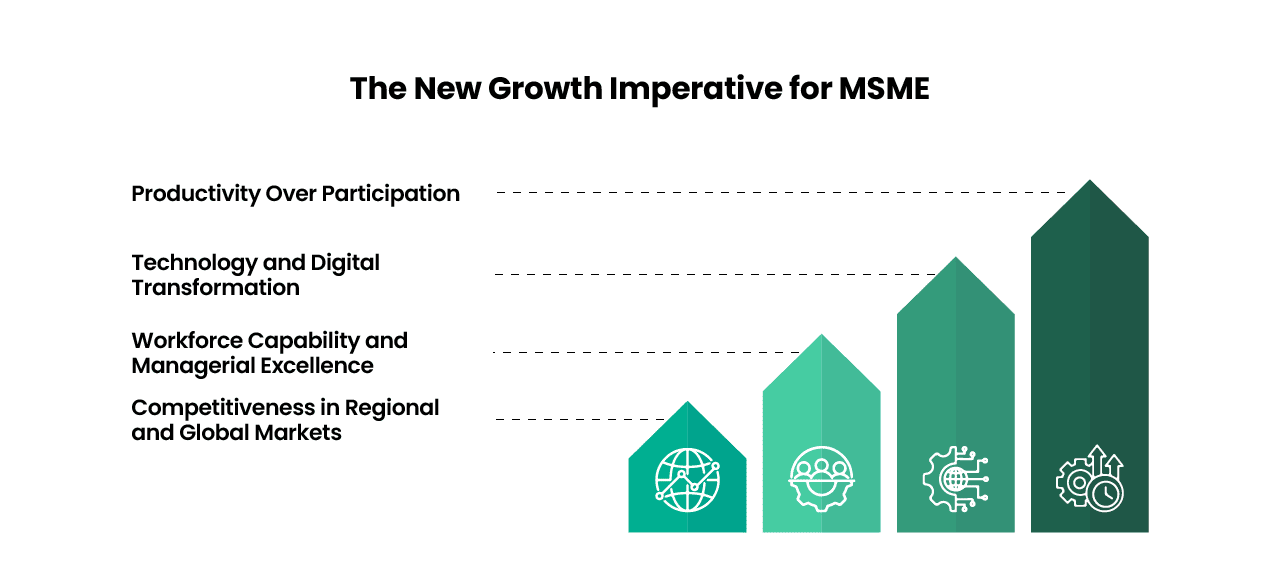
The next chapter of Nigeria’s MSME story will not be defined by the number of businesses created, but by the number that become productive, competitive, and resilient. Achieving this shift requires a new growth agenda built on four strategic imperatives.
- Productivity Over Participation: The success of MSMEs should no longer be measured by business registrations alone but by their ability to generate value, improve efficiency, and increase output. This requires adopting better business processes, strengthening operational excellence, and investing in innovation that enhances productivity.
- Technology and Digital Transformation: Digitalisation is no longer a competitive advantage but a business necessity. From e-commerce and digital payments to artificial intelligence and cloud-based solutions, technology enables MSMEs to improve efficiency, reach new customers, reduce costs, and respond more quickly to changing market demands.
- Workforce Capability and Managerial Excellence: Sustainable growth depends on capable leaders and skilled employees. MSMEs must invest in leadership development, financial management, digital skills, and strategic planning to strengthen decision-making, improve business performance, and build enterprises that can scale successfully.
- Competitiveness in Regional and Global Markets: The African Continental Free Trade Area presents a significant opportunity for Nigerian MSMEs to expand beyond domestic markets. To compete successfully, businesses must improve product quality, meet international standards, strengthen supply chains, and position themselves to participate in regional and global value chains.
Together, these imperatives represent a shift from supporting business creation to building growth enterprises that can drive productivity, competitiveness, employment, and long-term economic transformation.
Building the Next Generation of Growth Enterprises
Unlocking the full potential of Nigerian MSMEs requires coordinated action across government, financial institutions, the private sector, development partners, and the enterprises themselves. Sustainable growth will depend on creating an ecosystem that enables businesses to scale, innovate, and compete.
- Government: Government must create an enabling business environment by simplifying regulations, ensuring policy consistency, investing in critical infrastructure, and strengthening institutions that support enterprise development. Streamlined business registration, regulatory compliance, and export facilitation will reduce the cost of doing business and improve competitiveness.
- Financial Institutions: Access to finance must evolve beyond traditional lending models. Financial institutions should expand digital lending, asset-based financing, and other innovative funding solutions that reflect the realities of MSMEs. Stronger collaboration with fintech companies can also widen financial inclusion and improve access to growth capital.
- Private Sector and Development Partners: Large businesses and development institutions have a critical role in strengthening the MSME ecosystem through supplier development, market access, mentorship, incubation, and capability-building initiatives. Integrating MSMEs into corporate value chains will improve productivity while creating more resilient local supply networks.
- MSMEs: Enterprise growth ultimately depends on the willingness of business owners to evolve. MSMEs must move beyond survival-driven operations by investing in leadership capability, workforce development, technology adoption, sound governance, and business formalisation. Building sustainable enterprises requires a long-term commitment to productivity, innovation, and continuous improvement.
No single stakeholder can unlock Nigeria’s MSME potential alone. Lasting transformation will require a coordinated ecosystem in which policy, finance, capability, and market access work together to enable businesses not only to survive but to scale and thrive.
Beyond Start-Up: The Future of Nigerian Enterprise
Nigeria’s greatest economic opportunity does not lie in creating more entrepreneurs. It lies in building more enterprises that can scale, compete, and create lasting value. The country’s entrepreneurial spirit is undeniable, but its long-term prosperity will depend on transforming that energy into productive, innovative, and resilient businesses.
This shift requires moving beyond survival-driven enterprises to businesses that are built for growth. It requires greater investment in productivity, stronger leadership capability, wider adoption of technology, and deeper integration into regional and global markets. Above all, it requires an ecosystem that enables MSMEs to evolve from local businesses into competitive enterprises with national and international impact.
The future of Nigerian enterprise will not be measured by the number of businesses that are registered each year. It will be measured by the number that grow, innovate, create quality jobs, expand into new markets, and contribute meaningfully to economic transformation. That shift will determine Nigeria’s competitiveness in the decades ahead.
Call to Action
Realising this vision requires coordinated action from government, financial institutions, the private sector, development partners, and entrepreneurs themselves. Together, they must create the conditions that enable MSMEs to access finance, strengthen capabilities, adopt technology, improve productivity, and compete at scale.
The conversation must therefore move beyond encouraging business creation to deliberately building growth enterprises. When Nigerian MSMEs become more productive and globally competitive, they will do more than sustain livelihoods. They will strengthen industries, accelerate innovation, expand exports, create quality employment, and position Nigeria as a leading economic force on the African continent.
Author
Charles Kogolo