
There is a question sitting in every boardroom in Nigeria right now. It does not always get asked out loud, but it shapes every conversation about strategy, talent, and growth. Are our people genuinely ready for what AI is already doing to our industry?
For most organisations, if you push past diplomatic answers, the honest response is ‘no’ or ‘not yet’. That gap between where organisations think they are and where the evidence says they actually are subject to this article. It is also the reason Phillips Consulting, together with Skillsoft and LRMG, is bringing senior executives together on June 17th for a forum that goes beyond the usual conference talk and gets into what leaders can actually do.
The Numbers Are Uncomfortable, and They Are Real
Start with the World Economic Forum’s Future (WEF) of Jobs Report 2025. Based on surveys of over 1,000 global employers representing 14 million workers, the report projects that by 2030, 170 million new jobs will be created while 92 million are displaced, a net gain of 78 million roles on paper. Encouraging, until you look at the fine print. The skills required to fill those 170 million new roles are already different from what the current workforce possesses.
The WEF estimates that 39% of workers’ core skill sets will be transformed or become outdated by 2030. More sharply, out of every 100 workers globally, 59 will need reskilling by 2030, and 11 of those are unlikely to receive it, putting over 120 million workers at medium-term risk of redundancy. Not because their industries disappear, but because their organisations will not move fast enough to prepare them.
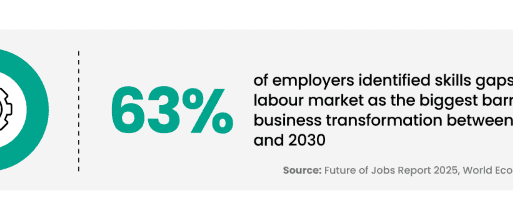
That institutional failure is already becoming visible. The World Economic Forum’s Future of Jobs Report 2025 found that 63% of employers identified skills gaps in the labour market as the biggest barrier to business transformation between 2025 and 2030. In other words, the problem is no longer whether disruption is coming. Employers themselves now admit that workforce capability is insufficient for the scale and speed of transformation already underway.
On the workforce side, Skillsoft’s 2024 survey of 2,500 full-time employees across four countries found that 35% lack confidence in the skills required to succeed in their current roles, and 41% are worried about job security because of those gaps. Leadership skills ranked as the single most critical competency for success, above technical skills and above AI proficiency. Yet only 28% rated their organisation’s leadership training as excellent. That is the gap where most transformation programmes quietly die.
Nigeria Is Further Along and Further Behind Than You Think
Nigeria’s relationship with AI is not a simple story of a country catching up. The country hosts over 400 AI-focused firms, second on the continent after South Africa, and attracted US$218 million in AI-focused venture capital in 2023. A 2025 white paper from Lagos Business School, developed with the Federal Ministry of Communications, found that 70% of Nigerian respondents expected generative AI to enhance their work efficiency, and 88% believed it would foster new skills and creativity.
The banking sector tells the most vivid version of this story. Nigerian banks collectively spent over ₦460 billion on technology infrastructure in 2024, with GTCO, Zenith, and UBA reporting year-on-year IT spend increases of 48%, 100%, and 107%, respectively. UBA formally rebranded its analytics function to “Artificial Intelligence and Advanced Analytics” in early 2025. These are not pilot programmes; they are institutional bets.
Yet, as recently as 2024, evidence from Nigeria’s retail banking sector showed that 73% of customers rarely engaged with the AI chatbots banks had invested heavily to deploy. The lesson from that period remains instructive: the technology arrived before the workforce was ready to make it work, in product design, in customer experience management, in ongoing system optimisation. The tools came first. The people were second thoughts.
This is the pattern across sectors. Telecoms companies are running AI-powered network optimisation systems, and their engineers have received no structured training in interpreting their outputs. Agricultural technology firms are deploying AI-driven soil analysis tools that their field agronomists were never trained to use. Across Nigeria’s economy, there is a growing chasm between what technology can do and what the workforce is equipped to do with it.
Organisations Think They Are Ready. Data Disagrees.
Here is what makes this harder than it looks. Most organisations genuinely do not know the size of their skills gap. Not because they are not paying attention, but because they are measuring the wrong things.
Skillsoft’s 2025 Global Skills Intelligence Survey, drawing on 1,000 HR and L&D professionals across four countries, found that 91% believe their employees overstate their proficiency in leadership, technology, and AI. Yet only 18% of those same organisations measure skills regularly throughout the talent development journey. The majority are making their most consequential human capital decisions, who to promote, where to invest in training, which roles to fill externally, on the basis of information they already know to be unreliable.
The consequences show up in real numbers. Only 10% of HR and L&D professionals are fully confident their workforce can meet business goals over the next 12 to 24 months. 28% of HR and L&D leaders identify skills gaps as the key factors that could make or break their organisation’s growth, including their ability to expand into new markets.
Spending money on training and actually closing skills gaps are not the same thing. The WEF’s 2025 data shows that 50% of the global workforce has completed training as part of long-term learning strategies, up from 41% in 2023. The spending is happening. The measurement that would confirm whether it is working is mostly not.
Skills intelligence, the continuous, systematic mapping of workforce capability against what roles actually require, is the mechanism that turns this around. Skillsoft’s platform data from 2025 shows a 74% year-on-year increase in AI learners and a 158% increase in total AI learning hours, with learners demonstrating an average 20% skill gain through outcome-based assessments. The gains are real when the learning is designed around measurable outcomes, not completion rates.
Nigeria Is Already Building the Model
The most ambitious workforce capability exercise currently underway in Africa is happening right here. Phillips Consulting, acting as lead consultant, has been leading the federal government’s Personnel Audit and Skills Gap Analysis (PASGA) programme under the Office of the Head of the Civil Service, a nationwide skills assessment covering Nigeria’s federal civil service, deploying an AI-driven platform, MuchSkills, to map competencies across ministries and agencies at scale.
The Head of the Civil Service of the Federation, Didi Esther Walson-Jack, has called it “one of the boldest investments in human capital transformation in the history of the Federal Civil Service.” Olawanle Moronkeji, COO of Phillips Consulting, described the shift from verification to skills assessment plainly: “This is where true transformation begins.”
Africa’s AI market is projected to grow from US$4.5 billion in 2025 to US$16.5 billion by 2030, a 27% compound annual growth rate, and could generate up to 230 million digital jobs across Sub-Saharan Africa. Nigeria, with its demographic scale and entrepreneurial energy, is positioned to capture a disproportionate share of that, but only if the workforce is ready. And the workforce will only be ready if the organisations employing it decide to take that preparation seriously now, not in the next budget cycle.
As Abubakar Suleiman, MD/CEO of Sterling Bank, declared at the Innovate AI Conference in Lagos: “Companies that fail to embrace AI will become less competitive, and they will die.” That is strategy. Not hyperbole.
An Invitation to the Conversation That Matters
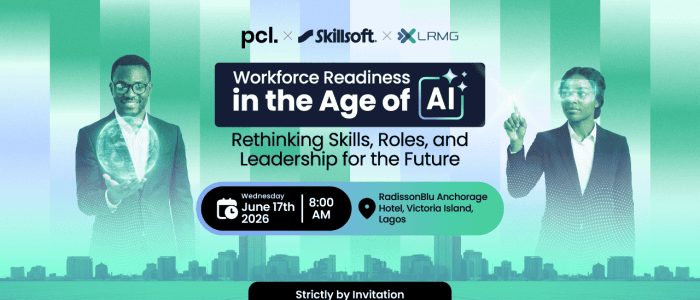
On Wednesday, June 17th, 2026, Phillips Consulting, in collaboration with Skillsoft (trusted by approximately 70% of the Fortune 1000 across 160+ countries) and LRMG, our Pan-African partner, is convening an executive breakfast forum at the Radisson Blu Anchorage Hotel, Victoria Island, Lagos, beginning at 8:00 AM.
The theme: Workforce Readiness in the Age of AI: Rethinking Skills, Roles, and Leadership for the Future.
Opening keynotes will be delivered by Temi Dalley, Group Executive for Human Capital and Corporate Services at Sterling Financial Holdings Co., one of Nigeria’s most experienced voices on people strategy inside a complex financial institution, and Sally Acton, Chief Experience and Innovation Officer at LRMG, who brings a continental and global perspective on how organisations are rebuilding their learning ecosystems at pace.
The panel will feature Dr. Joshua Ademuwagun, Human Resources Director at Pernod Ricard Nigeria, whose vantage point inside a global consumer goods business operating in one of Africa’s most dynamic markets makes him uniquely placed to speak to the intersection of global standards and local workforce realities; and Yemi Faseun, Chief Talent Officer at YF Talent Partners, one of the most respected independent talent voices in the country.
The discussions will cover three intersecting themes:
01 How AI is disaggregating roles and changing the skills required to fill them
02 Practical approaches to reskilling at scale using skills intelligence
03 What it specifically takes to lead through high-change, AI-enabled environments,
qualities that, the research consistently shows, are human and relational, not technical
This forum is by invitation only and is designed exclusively for CEOs, Managing Directors, Executive Directors, Chief People Officers, HR Directors, and Chief Learning Officers. Seating is deliberately limited to ensure meaningful engagement and high-value conversations.
The workforce of tomorrow is being shaped or neglected in decisions made today. On June 17th, make sure you are in the room that makes the difference.
To confirm your attendance, contact enquiry@phillipsconsulting.net | +234 (0) 906 000 0804
This article was developed with the support of AI-assisted research and writing tools.
Written By
Paul Ayim